“We hope to achieve a 9.3 or 9.4%, “ (referring to the annual GDP growth) and, given our potential for addressing new reforms, this growth rate can easily become a 10%”, assured Rajiv Kumar Director & Chief Executive of the Indian Council for Research on International Economic Relations (-ICRIER- New Delhi) to the people, who was taking part at the Forum on India, which was held on 5th, 6th and 7th November, under the title `India the Democracy of the Diversity´, in Madrid. As promissed in February, it is published now the 2nd part of the report on the mentioned India Forum.

of Indian Forum 2007`The Democracy of the Diversity´
Both Kumar and the rest of panellists know first hand, how it is the social and economical situation in India going on. All of them spoke, well grounded, about the development in this market, which soon will count with 300 million middle class ‘wallets´.
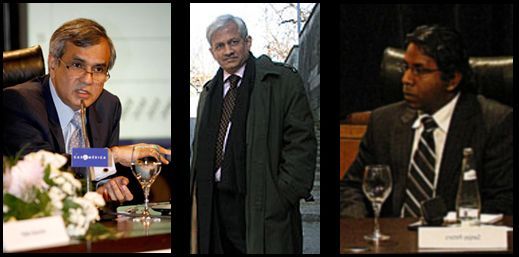
Najib Padar (Secretary of Embassy of India in Spain), Ashutosh Varshney, Director of the Center for South Asian Studies (University of Michigan), Christophe Jaffrelot, Director of Centre d’Etudes et de Recherches Internationales (París), Sanjay Peters, bachelor by the University of Cambridge, consultant to the UN and the World Bank and professor of economics in ESADE, Sundeep Walsekar, President of the Strategic Foresight Group (Mumbay) and Xenia Dormandy, Executive Director of the Belfer Center for Science and International Affairs (Hardvard University), talked hand in hand with Sanjay Peters and such interesting Spanish speakers as Pablo Bustelo (First Researcher for Asia-Pacífic of Real Instituto Elcano), Eva Borreguero (Director of Educative Programmes of Casa Asia) or Vicente Garrido (Director of INCIPE).
They all analysed the past, the present and the future of India as an Asian power bound to play an important role in the global international landscape.
Federico Ysart, Director of the Laboratory for the Analysis of Tendencies and member of the board of the Marcelino Botín Foundation (organizer of the forum) played the role of the ceremony master.
Emilio Lamo de Espinosa, catedrático of Sociology of the Universidad Complutense of Madrid, inaugurated this and Fernando Delage, Director of Casa Asia in Madrid,closed it: “It is a mistake leaving aside India at the time of deciding where to invest”, he stated.
Some disadvantages that generate business opportunities
During the meetings (they were three round tables) all of them talked about India as a plural country, full of contradictions, which offers many opportunities for investors and agile visionary entrepreneurs, despite its many problems and also despite that there is a long way to run for this nation.

Among te advantages listed by Kumar, they were: The enterpreneurial spirit, a young population, that will remain young for a long time in the future, the fact that India is an stable democracy and R&D costs far below the ones offered by other countries. Among the disadvantages he told about: Povertry, the inequal distribution the economic growth between urban areas and rural areas, the bureaucracy, the lack of infrastructures. Kumar also referred to some other disadvantages, that are considered in greater detail below in this report.
“But, precisely in some of these outstanding issues can be found good business opportunities within the country”, said Kumar.
Towards a more flexible labour market
There is a progressive exit of the indian government from certain sectors, so there is more room for private investment in them, assured Kumar. Yet, for Christophe Jaffrelot,Director del Centre d’Etudes et de Recherches Internationales (París):”Many of the major companies in the country remain public and, while this public sector employs 90 million people, the formal private sector only accounts with 8 million workers”.
Kumar and Sanjay Peters(ESADE) agreed with these figures. Although the first one pointed out that the public presence in the Indian economy is declining in terms of capital, but it is certainly still strong in terms of employees. There is a problem of lack of flexibility in the Indian labour market. In Kumar’s view, it is necessary to tackle serious reforms, but the Socialists, part of the government coalition, usually veto any progress in this regard. According to the Director of ICRIER: “They are afraid that the reforms will translate into a decline in protecting the rights of workers”.
Bureaucratic resilience against change
Sundeep Walsekar, President of the Strategic Foresight Group (Mumbai) referred to the bureaucratic resilience within the Indian parliament, at the time of adopting any reform in favour of flexibility. He also told about the bureaucratic resistance against any reforms, which are necessary for the successful development of the Indian economy and society. Bureaucracy is for Walsekar all those, who are employees in public enterprises, and are afraid of any changes that might affect the wealthy, confortable and safe situation, that they enjoy.
There is an entrepreneurial class, assured Walsekar, “but the problem is that the enterpreneurs are not the people, who decide”. Thinking deeper about this matter, Ashutosh Varshney, Director of the Center for South Asian Studies (University of Michigan) noted: “Perhaps, the problem is not the bureaucracy, but actually the fact,that in India it is not `anybody´, who is undertaking, as it has happened in other countries. If it really were ‘anybody’, wo were undertaking, perhaps it would be easier to defeat this resistence and, therefore, also introducing changes”.
A slow but secure democracy
All speakers agreed on that India is the oldest Eastern democracy. This fact guarantees a greater stability and a reduces the risk of nationalizacion for investors. Yet, all of them agreed on that it is also the democratic system and the existence of a government coalition, the fact which hinders any reform at same speed as it can be undertaken in China. The democracy hinders therefore such a fast growth, as the one reached within the neighbour country.

Even so, Ashutosh Varshney, Director of the Center for South Asian Studies (University of Michigan) prefers India far more than China at the time of investing: “First, of any revenues obtained by a company in the most important markets, 2/3 are for the government and only 1/3 for individuals, due to the large state involvement in enterprises. Secondly, there is the question of the copycats. If there is no adequate protection of industrial property the enterpreneurs hold back”.
Education and job creation to take advantage of the demographic dividend
While the Chinese population will stop its growth in 2010,it will not happen the same to India until 2035. Not only will be more Indians, but that there will be more young people under 35 years willing to work and generate wealth. Bustelo (RIE) pointed though: “The demographic advantage is not enough, this advantage must be seized”. Kumar (ICRIER) referred to 2 facts that can turn the demography to disadvantage: Unemployment and lack of education. He said about this: “Only a 9% of the Indian children begins a secondary education and, of this 9%, only a 30% goes to the university. We cannot leave in the hands of the private initiative the task of education. We need a strong State investment in order to deliver a basic education with enough quality “. In addition, many of the young people, wo start at the university goes abroad to study and then they don´t return because there’s a lack of suitable jobs within the country. Kumar added: “There is also a need to create enough jobs in the private sector, not only to employ these future workers but to relocate all those, who lost their jobs, due to the public exit from some economic sectors”. Walsekar, President of the Strategic Foresight Group (Mumbai), added on this subject: “Only a GDP growth of two digits can ensure that it will be created the amount of jobs, which is needed”.
Atomic plants against energy dependence?
Xenia Dormandy, Executive Director of the Belfer Center for Science and International Affairs (University of Hardvard), referred to the important role it plays India today at an international level. Since the strategic point of view, India can become an important ally for USA with a view to avoid the advance of China and some conflicts both in the area and in the world (terrorism), due, among many other factors, to the instability in Pakistan.

Dormandy also analysed the relationship between India and the USA, with regard to the development in the infrastructure and the energy fields, with special attention to nuclear energy.
According to data provided by this advisor to the US government, the Indian government needs approximately $500,000 million to build infrastructure in the country. USA has become a good outsourcer of India, especially in the field of technological products and nuclear fuel.
The Asian country is not able to satisfy the domestic needs, so that it imports a 70% of the oil and a 50% of the gas consumed within India. Within the field of nuclear energy, this nation only covers a 3% of its total needs with nuclear sources, compared to France (a 70%) and China (a 30%).Yet the government favors the nuclear development, which is not very adecuate to protect the environment, for several reasons. Some of them, economical reasons (as it is more affordable than some renewable and can reduce the dependence on foreign sources). Other are political reasons. Some relate to the strategical defence against other nations, as Pakistan. Some others with the fact that the government considers the nuclear development a way to win not only international prestige, but also global influence.
Xenia Dormandy indicated also that, today, US only provides India with nuclear fuel and technology for not military uses. Both countries are good business partners although India, due to its colonial history, is very careful in order to maintain its independence from the US.
The queen in the pond, the shy calf and the lion
According to Sundeep Walsekar, President of the Strategic Foresight Group (Mumbai) it is necesary to watch under the surface in order to understand what is actually happening in India. “Those visiting India tend to see my country in one of the following ways. As the frog in the pond, which croaks, proud of itself, as the queen of the marsh. As the calf in the shadow of his mother, who comes timid but seeks her protection. As the lion, on the shield of our nation. A lion,that looks around with confidence and decides”.

According to Sundeep Walsekar, President of the Strategic Foresight Group (Mumbai) it is necesary to watch under the surface in order to understand what is actually happening in India. “Those, who visit India, tend to see the country in one of the following ways. As the frog in the pond, which croa proud of itself as the queen of the marsh. As the calf in the shadow of his mother, who comes timid but seeks her protection. As the lion, on the shield of our nation. A lion,that looks around with confidence and decides”.
“Depending on where you come from and how you are, you will see Indiain one of this ways, but the fact is that India is the 3 at the ame time”. And continued “…the question is knowing how interact these 3 mindsets, how do they play”.
Looking at the future, the President of the Strategic Foresight Group predicted: “looking towards the next fifteen years the question to be answered is: ¿What can be done in India with the bureaucratic economy?. If these many millions of people are transferred from the bureaucratic sectors of the economy and get integrated into the market economy, may be India become the lion, but if not…”.
“What may India become has much to do with what happens with the bureaucratic economy” … “The opposition to the reforms within the parliament has to do with the leftwing bureaucratic economy “… “the less bureaucratic economy the most legislative progress for the goverment to implement policies for developing the market economy in the country “.
A book on the Indian Forum 2007
The Marcelino Botín Foundation will edite a book, in which the content of the Forum India 2007 will be included. The mentioned foundation is already preparing the next meetings. Federico Ysart announced also that in 2009 the forum will be devoted to Russia.
eastwind published last month the first part of this repport on the economical development in the oldest Asian democracy.
A shortcut of the whole report can be found on eastwind newsletter 2007, 12th-19th Nov.