President Yoon’s lift of martial law in South Korea has not been enough to avoid Korean stoks fall while it has proved effective to contain the sink of korean won’s price against US dollar.
KOSPI (Korea Composite Stock Price Index), the benchmark index of the South Korean equity market, fell around a 1,15% at the opening.
Banks were among the worst hit in today’s selloff, along with companies considered as related to Yoon policies. Among these policies they are nuclear energy and corporate reform.
Samsung Electronics Co. shares suffered the biggest sink on the KOSPI, although finally falling just a 0.9%. This tech giant is the largest company in the country.
The political crisis in South Korea has had some impact in New York stock exchange and the European markets on 3rd December, but limited to South Korean companies and investment funds traded on them both directly and through the ADR in New York or London.
The initial sink in New York experienced by e-commerce giant Coupang (8,5%) and the steel manufacturer Posco (7,3%) finally moderated to a 4% in both cases.
Telecommunications company KT Corp fell a 5% but at the end of the session the downward adjustment reduced to a 1%.
In Europe the fell down was even more moderated, with Samsung titles loosing finally around a 3% although first adjustment reached a -7%.
Kim Byoung-hwan (Chairman of the Financial Services Commission) said after an emergency meeting that Authorities will take “all possible measures” to ensure the stability of markets. He assured as well that a 10 trillion won ($7Bn) stock market stabilization fund was ready to be instantly used if needed.
Bank of Korea’s monetary board held an extraordinary meeting to discuss steps to shield the economy and markets. Among the meassures to be adopted is providing as much liquidity as needed.
While the KOSPI showed hard to recover, the Korean won started a more or less clear path to recover normality after the lift of the martial law.
The USD/KRW exchange rate (NDF) had surged to 1,444 KRW for 1 USD following the declaration of martial law but closed at 1,415.8 KRW and had reached the 1413, 89 on 4th December at 05:49 pm Seoul hour (09:45 am Madrid hour).
Foreign currency funding for onshore banks has also been refinanced smoothly, proceeding without any disruptions, explained the press release issued by ROK’s Ministry of Economy after the 2nd Econmy Emergency Meeting held today at 7:00 am Seoul hour (11pm still on 3rd December Madrid hour).
4th largest economy in Asia and not only contributing to development in poor countries
The ROK is the 4th largest economy in Asia and the 12th largest in the world as of 2024.
Following the latest report on Korea published by OECD GDP, growth in Korea has recovered, supported by strong exports. Employment remains stable at a high level, while unemployment is low. Interest rates have likely peaked and housing prices have stabilised, all of which should support consumption going forward.
South Korea was the first former aid recipient to become a member of the Development Assistance Committee (DAC) of the Organization for Economic Cooperation and Development (OECD) in 2010.
This Asian country is a key development partner of the World Bank Group (WBG) and an important contributor (since 1977) to the International Development Association (IDA), the World Bank’s fund that supports the world’s poorest countries. Today Korea’s experience offers lessons for developing countries in sustainable development, provision of infrastructure and better services to improve the lives of the people, and how to transition to a dynamic knowledge economy.
And the return to democracy in 1987 has with no doubt been a key driver boosting theso called South Korean economic miracle.
The main destinations of South Korean exports in 2023 were China (PRC), the USA, The European Union, Vietnam, Japan and Hong Kong.
During Biden’s Administration South Korean companies like Samsung and Hyunday have announced significant investments in the USA in the microchip mannufacturing and green cars manufacturing field.
Companies based in the Asia-Pacific region have announced almost $200Bn of investments into the United States since the start of the Biden-Harris Administration, and Samsung heads the list with far over $20Bn planned alone or with other South Korean partners.
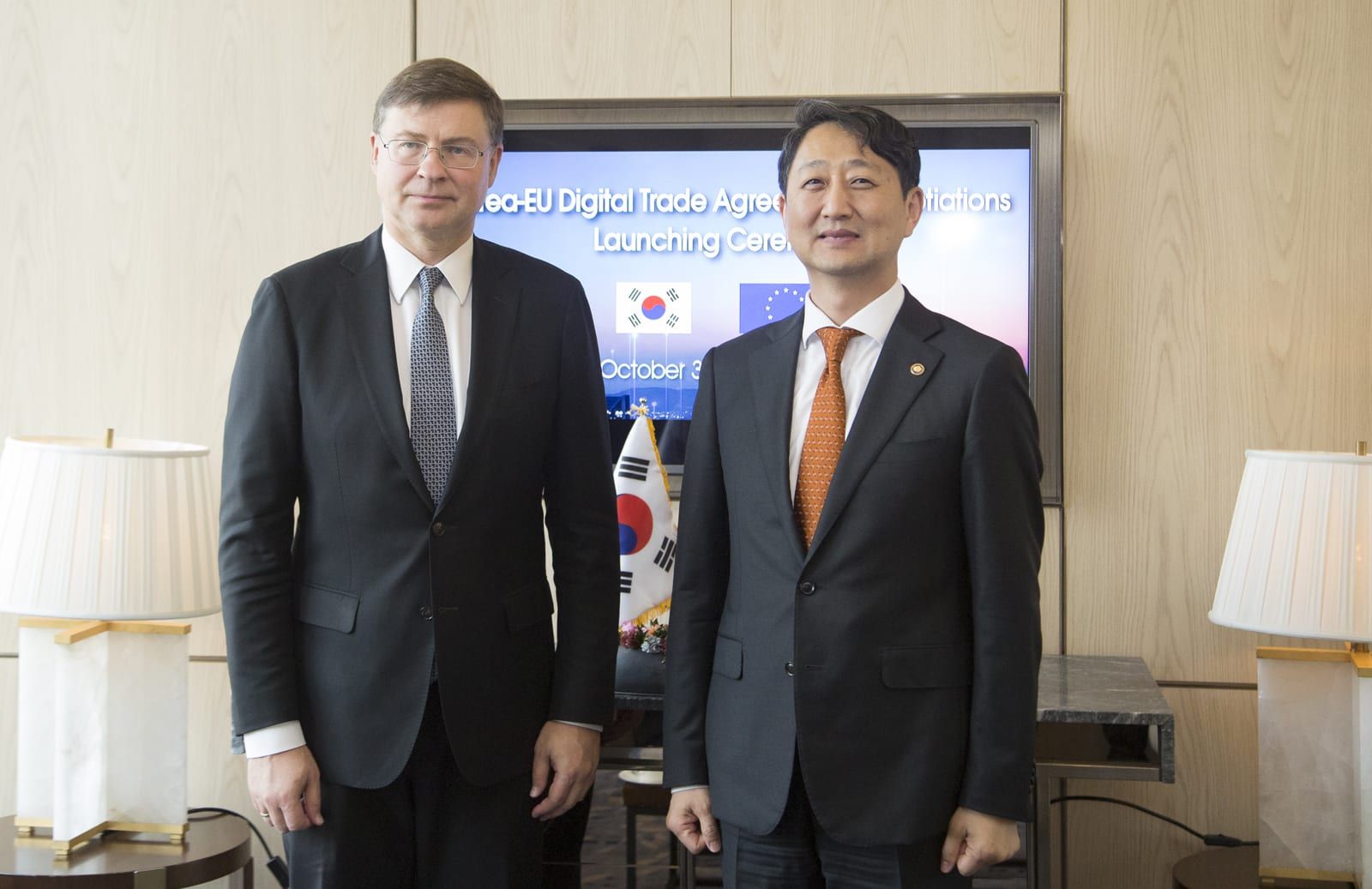
The Republic of Korea is the EU’s 8th largest trade partner in goods, whereas the EU is Korea’s 3rd largest trade partner in goods. The EU remains the Republic of Korea’s biggest foreign direct investor, with an FDI stock of €54Bn (2022), ahead of Japan and the United States. Among EU Member States, the Netherlands, Germany and Luxembourg were the largest investors in 2022, with financial, insurance and other professional services attracting a significant part of FDI from the EU. Korean investments into the European Union have also grown reaching €40.6Bn in 2022. About the 75% of the volume of EU outward stocks.
Korean investments are particularly focused on the electric vehicles sector, with Hungary, Poland and Germany being the largest investment destinations in 2022.
The EU’s trade relations with the Republic of Korea are governed by the EU-Republic of Korea Free Trade Agreement (FTA), provisionally applied since July 2011 and formally ratified in December 2015. The FTA was the EU’s first with an Asian country and the first to include a chapter on trade and sustainable development.
To complement the FTA, the EU and the Republic of Korea launched negotiations for a digital trade agreement on 31 October 2023, building on the EU-Republic of Korea Digital Trade Principles agreed in 2022. Both sides intend to agree on a set of ambitious, modern digital trade rules, building on and complementing the existing preferential trade framework.
Leaving aside the economic partnerships and trade relations, South Korea has proved to be EU’s most valuable political ally in Asia. ROK is as well one of best associate partners for NATO in the region given the rise of the worldwide influence of China.
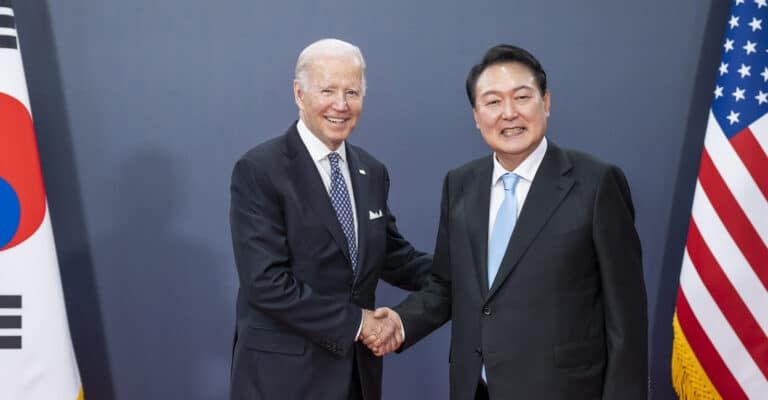
Image over the headline.- POTUS Joe Biden on the left shaking hands with ROK President, Yoon Suk Yeol on the occasion of one official visit to South Korea. Image by the Office of the President of the United States though Wikimedia Commons. To watch the original image and read the terms of the lisense click here
Related Eastwind links:
ROK’s President Yoon Suk Yeol lifts martial law and now faces impeachement motion