In 2015, the Islamic State’s (ISIS) caliphate shrunk from 90,800 km2 to 78,000 km2, a net loss of 14%. And latest analysis on the matter released today by IHS Markit shows that in the first nine months of 2016, that territory shrunk again by a further 16%. As of 4th July 2016, the Islamic State controlled roughly 68,300 km2
On 3rd October 2016, the Islamic State controls roughly 65,500 km2 in Iraq and Syria. The territories currently under the IS roughly reach the same size of Sri Lanka.
The Islamic State’s losses in Syria over the last three months have been concentrated in northern Aleppo province, where Turkish proxy groups have pushed the jihadists back to around 10km from the border with Turkey. In Iraq, government forces have secured Qayyarah Airbase in Iraq’s Nineveh province, a critical staging area for the anticipated offensive to liberate Mosul.
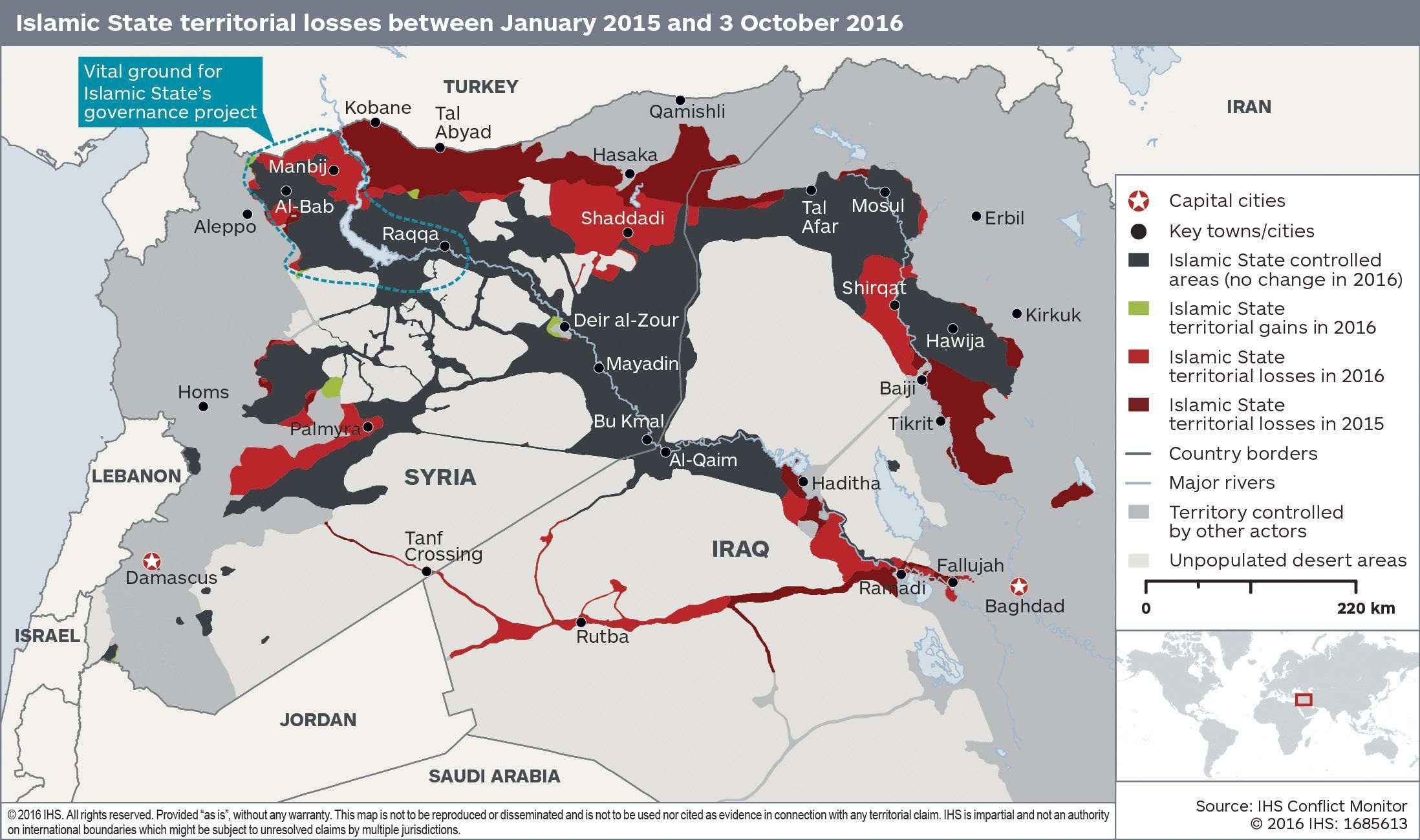
“The Islamic State’s territorial losses since July are relatively modest in scale, but unprecedented in their strategic significance”, said Columb Strack, senior analyst and head of the IHS Conflict Monitor. “The loss of direct road access to cross-border smuggling routes into Turkey severely restricts the group’s ability to recruit new fighters from abroad, while the Iraqi government is poised to launch its offensive on Mosul.”
Despite ISIS Califate is experiencing strategical territory losses, Russian and Turkish interest in the region could slow down ISIS’s fall.
Drop in SDF fighting by Turkish position could stagnate ISIS shrink
IHS Conflict Monitor recorded an 87% drop in the volume of fighting between the SDF and the Islamic State from August to September.
Turkey’s intervention in northern Syria may well be the reason why the US-backed Syrian Democratic Forces (SDF) operations against the Islamic State, which led to the liberation of Manbij in August, are now somewhat stalled.
“There is deep underlying competition between the Kurdish-dominated SDF and Turkey’s Sunni proxies over their conflicting ambitions for Syria’s future,” Strack said. “For the time being, the US is cooperating with both, but once the Islamic State has been defeated as a conventional force, Washington will have to pick a side.”
Given Turkey’s vehement stance against Syria’s Kurds, US support for them is more likely to be sacrificed IHS report points.

“The Kurds know that support from the US may dry up,” Strack said. “They will be looking for assurances from the US on their plans for federal governance as a precondition for their involvement in any offensive on Raqqa.”
Russian support to Assad in Syria, also delaying ISIS drop
The share of Russian airstrikes targeting the Islamic State in Syria, as recorded by IHS Conflict Monitor, has reduced since the start of the year. In Q1 2016, 26% of recorded Russian airstrikes targeted the Islamic State. That reduced to 22% in Q2 2016, and to the 17% in Q3 2016. Less airstrikes by Russia do not precisely push forward IS shrink.
“Last September, President Putin said it was Russia’s mission to fight international terrorism and specifically the Islamic State,” explained Alex Kokcharov, principal Russia analyst at IHS Country Risk. “Our data suggests that is not the case. Russia’s priority is to provide military support to the Assad government and, most likely, transform the Syrian civil war from a multi-party conflict into a binary one between the Syrian government and jihadist groups like the Islamic State; thereby undermining the case for providing international support to the opposition.”
Image over the headline.- Kurdish YPG and YPJ Fighters. YPJ (YJÊ ) are women fighters trained by the Kurdish Workers Party guerillas to defend themselves against Islamist extremists. Photo uploaded at Flikr by kurdishstruggle and licensed under creative commons. To read the terms of the license click here . To watch the original photo click here
Related external links: