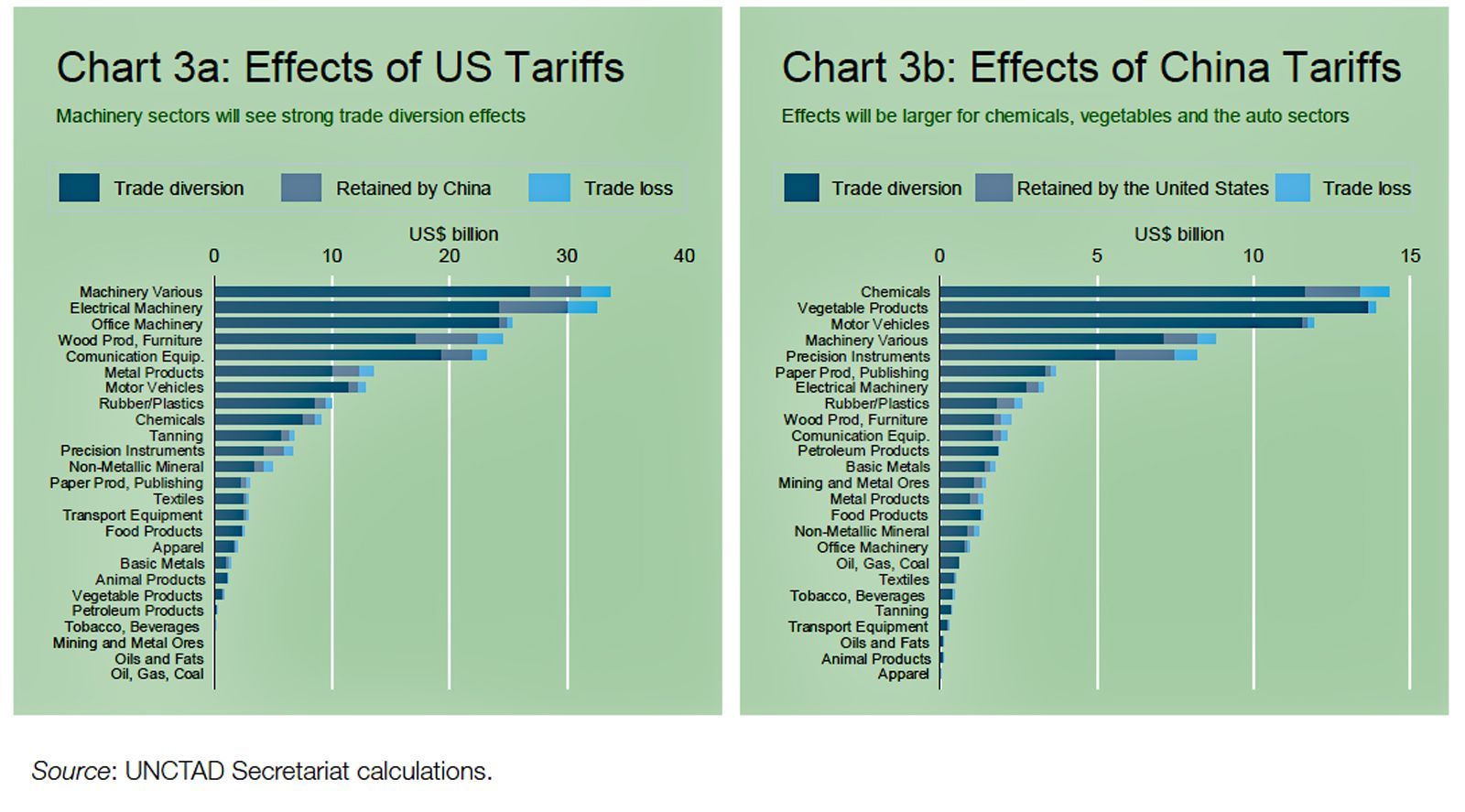
Of the $250Bn in Chinese exports subject to US tariffs, about 82% will be captured by firms in other countries, about 12% will be retained by Chinese firms, and only about 6% captured by US firms, those are data from the report titled Trade Wars: The Pain and the Gain, published today by UNCTAD that underlines how bilateral tariffs would do little to help protect domestic firms in their respective markets, while will pour counless dammages to growth for them and developing countries.

“Because of the size of their economies, the tariffs imposed by Unites States and China will inevitably have significant repercussions on international trade,” said Pamela Coke-Hamilton, who heads UNCTAD’s International Trade Division, as she launched the Key Statistics and Trends in Trade Policy 2018.
The study shows who’s feeling the pain and gain derived from the trade wars triggered by the US protectionist policies that President Trump is carrying out and the protectionist counter mesures of China. The report also provides a deep look into the effects of the ongoing wrangling situation.
The ongoing trade tensions initially came to a head in early 2018 when China and the US imposed tariffs on about $50 billion of each other’s goods. The confrontation quickly escalated, and in September 2018 the US imposed 10% tariffs covering about $200 billion of Chinese imports, to which China retaliated by imposing tariffs on imports from the US worth an additional $60 billion.
The 10% tariffs were initially due to rise to 25% in January 2019. However, in early December 2018 the parties agreed to freeze the tariff increase until 1 March 2019.
Tariffs to US productos in China will result just in a 5% share hike for Chinese companies in their domestic market
Of the approximately $110 billion in US exports subject to China’s tariffs, about 85% will be captured by firms in other countries, US firms will retain less than 10%, while Chinese firms will capture only about 5%. The results are consistent across different sectors, from machinery to wood products, and furniture, communication equipment, chemicals to precision instruments.
The reason is simple: bilateral tariffs alter global competitiveness to the advantage of firms operating in countries not directly affected by them. This will be reflected in import and export patterns around the globe.
EU countries will benefit the most from US-China trade war
European Union exports are those likely to increase the most, capturing about $70Bn of US-China bilateral trade ($50Bn of Chinese exports to the US, and $20Bn of US exports to China). Japan, Mexico and Canada will each capture more than $20Bn.
UNCTAD grounds the forecast on EU companies gains on the fact that are expected to benefit the most from US-China tensions are those which are more competitive and have the economic capacity to replace US and Chinese firms.
Substantial effects relative to the size of their exports are also expected for Australia, Brazil, India, Philippines, Pakistan and Viet Nam.
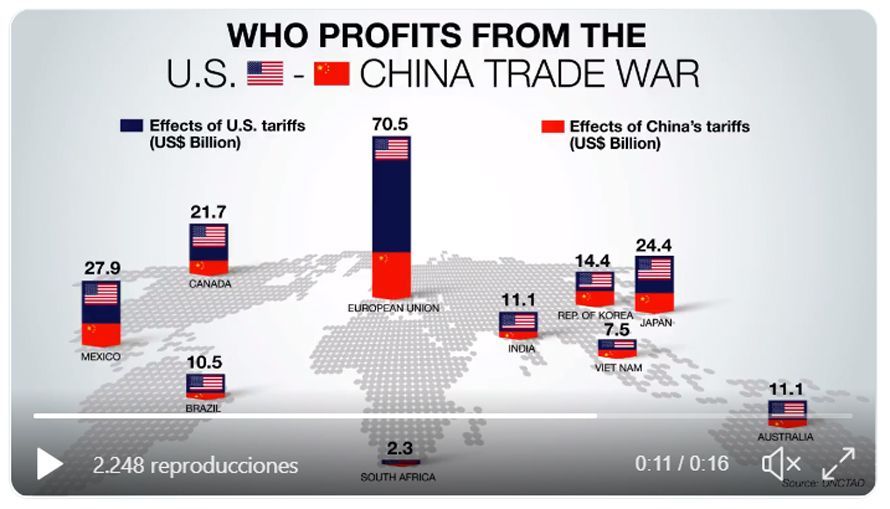
Although these figures are not a large slice of global trade (which was worth about $17 trillion in 2017) for many countries they make up a substantial share of exports. For example, the approximately $27Bn of US-China trade that would be captured by Mexico mean a worth to be considered 6% share of Mexico’s total exports.
Not all effects will be positive, even for those countries profiting from the trade war
UNCTAD study shows that the new supply-demand scheme generated by the trade war between China and the USA will also cause negative effects, even in those countries gaining share in international exports:
1.- The amount and duration of tariffs are not enough clear, so producers are reluctant to make investment decisions that may turn out to be unprofitable if the tariffs are revoked, so domestic markets will experience price hikes, even shortages in supply.
This has happened for example in the case of the Brazilian soy farmers. Chinese tariffs on US soybeans have resulted in trade distortionary effects to the advantage of several exporting countries, in particular Brazil, which suddenly became the main supplier of soybeans to China.
The other side of the soy tariffs coin is that Brazilian firms operating in sectors using soybeans as inputs (such as livestock feed) are bound to lose competitiveness because of price rises caused by Chinese demand for Brazilian soybeans.
2.- while some countries will see a surge in their exports, negative global effects are likely to dominate
There’s a common concern by the fact that trade disputes will have an impact on the still fragile global economy that can’t be avoided. An economic downturn often brings with it disturbances in commodity prices, financial markets and currencies. And all of this disturbances will have important impacts in the economies of developing countries. One major concern is the risk that trade tensions could trigger a spiral of currency wars, making dollar-denominated debt more difficult to service.
3.-If other countries join the fray weaker countries will suffer the most
There’s a risk that more countries may join the fray so that protectionist policies could escalate to a global level. As protectionist policies generally hurt weaker countries the most, a well-functioning multilateral trading system able to defuse protectionist impulses and maintain market access for poorer countries is crucial, UNCTAD points.
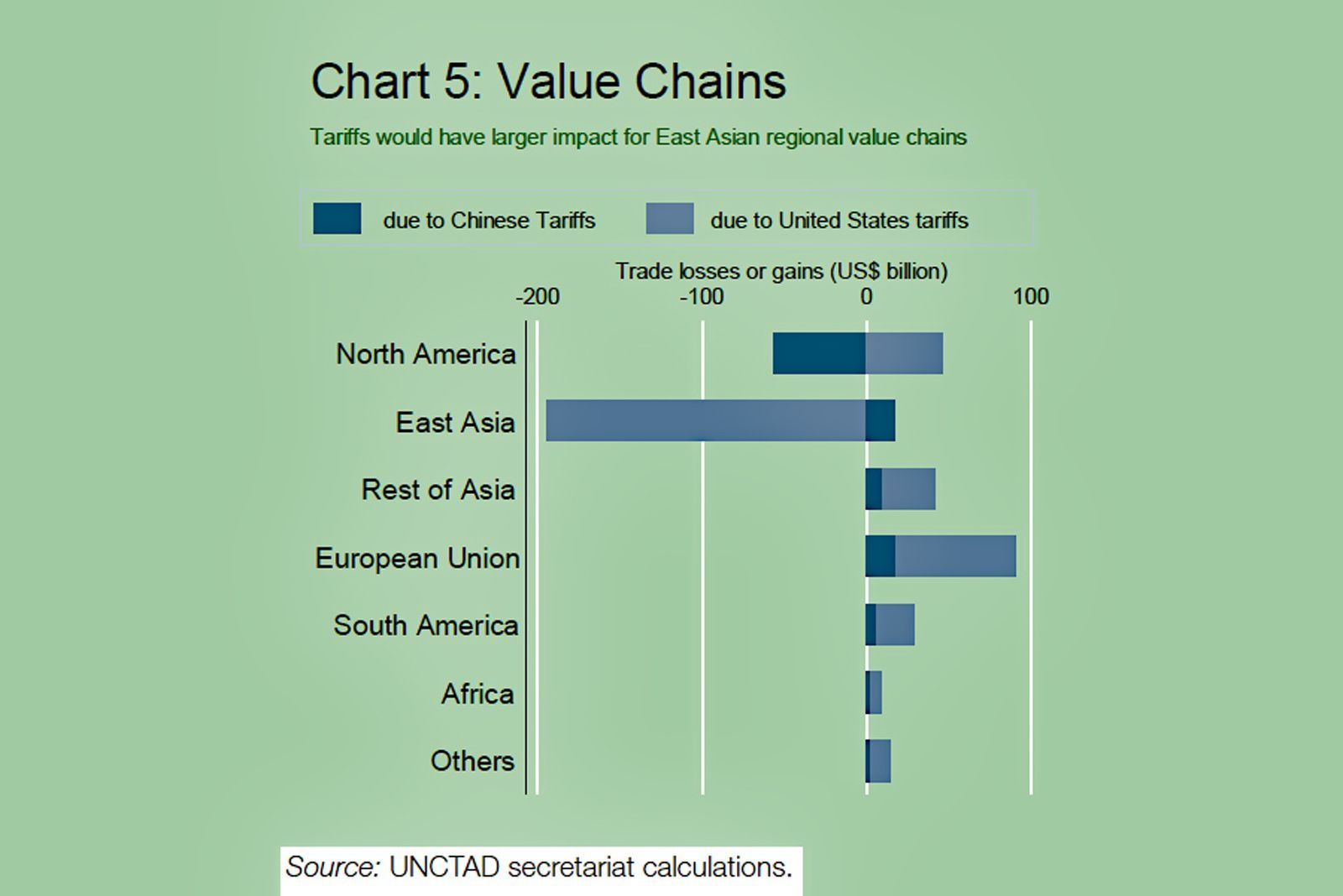
4.- The tit for tat moves in tariff hikes between the USA and China are likely to have a domino effect beyond the countries and sectors targeted
In an interconnected global economy, a trade wars between the global economic giants are likely to have a domino effect beyond the countries and sectors targeted.
Tariff increases penalize not only the assembler of a product, but also suppliers along the chain. For example, the high volume of Chinese exports affected by US tariffs is likely to hit East Asian value chains the hardest, with UNCTAD estimating that they could contract by about $160Bn.
Image over the headline.- A customs border clearance agent assigned to Navy Customs Battalion Romeo keeps record of each inspection (via Wikimedia, US Navy 061209-N-8148A-067)
Related external links:
UNCTAD REPORT.- Key Statistics and Trends in Trade Policy 2018