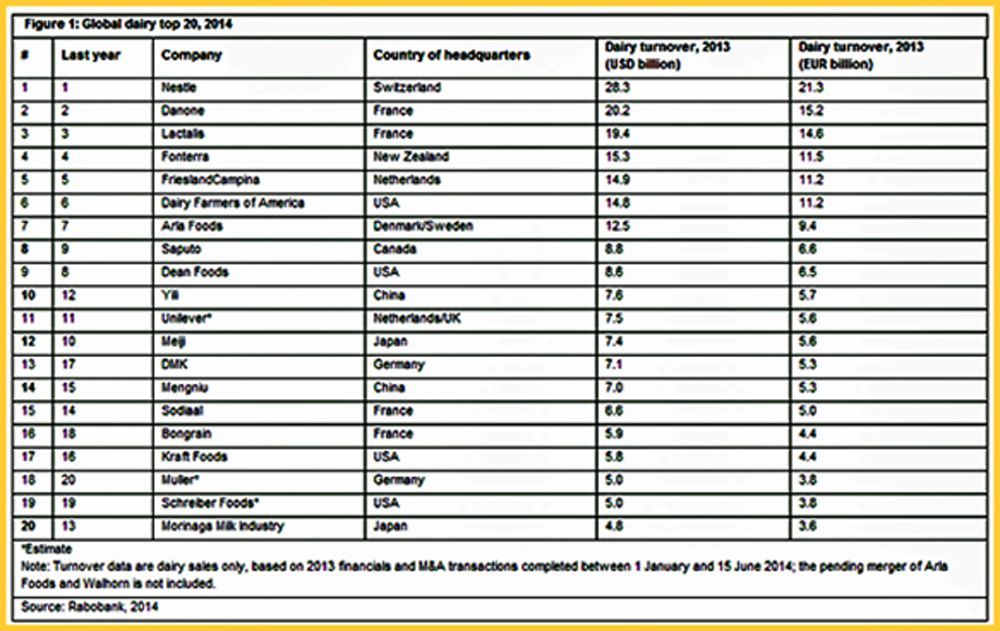
The Chinese company Inner Mongolia Yili Industrial Group Co. has been ranked 10th in the latest Global Dairy Top 20 yearly report for 2014 recently published by Rabobank.It is the first time that a Chinese company enters the 10 head group in this sector.
There are just three other Asian companies in the Top 20 list, Japanese, Meiji and Morinaga Milk Industry, and one from China, Mengniu. With $7.4Bn (€5.6Bn) turnover in 2013 Meiji goes down to the 12th spot this year from the 10th position achieved in the 2013 ranking. Morinaga Milk Industry drops from 13th place reached in 2013 to the 20th with turnover declared for 2013 at $4.8 Bn (€3.6Bn).
The melamine contamination scandal that bursted in 2008 before the Olimpics in Beijing seems to have been left far behind, at least attending to the $7.6Bn turnover (€5.7Bn) declared by Yili in 2013 and the $7Bn (€5.3Bn) turnover posted by Mengniu that have made the Chinese dairy go up from the 15th spot reached in 2013 to the 14th in 2014 ranking.
Yili started to create an overseas footprint last year by investing in a milk powder project in New Zealand.The Chinese company also entered into a strategic cooperation with the U.S. largest milk cooperative, Dairy Farmers of America, and the Italian dairy producer, Sterilgarda Alimenti S.p.A.At the beginning of this year, Yili expanded its research and development efforts abroad by establishing a European R&D Center with Wageningen University, a top-level university in the Netherlands. Both parties have also signed a strategic agreement to set up the first Sino-Dutch food safety guarantee system.
Industry insiders consider that these overseas moves have comprehensively improved Yili’s control over the industrial chain and its own brand influence globally, further helping it become a dairy giant worldwide. These moves as a whole have acted as drivers for Yili to jump from the 12th spot it achieved in the Rabobank 2013 ranking to the 10th position reached in 2014 report.
Yili’s enter into the top ten dairy companies worldwide is partly owed, thinks the Chinese company itself, to the huge market demand due to the country’s economic development. Robust expectations for growth across the dairy sector allow producers in emerging markets to accumulate enough capital, develop the motivation to participate, become an influencer and even improve the industrial chain globally, giving them the final say in resource allocation, underscores Yili.
Another influential factor, continues explaining the Chinese company, is the public’s rediscovery of the power of Chinese businesses as international consumers re-assess made-in-China products and services, and move them into their list of “want to have” items. Gradually these products and services are evolving into an indispensable part of day-to-day life.
China, a key market for the future, in Rabobank’s view
Positioning for maximum effectiveness in the expanding Chinese market remains prominent, says Rabobank report.
In 2013, joint ventures were announced between Mengniu and Whitewave and COFCO and Danone while Yili announced a partnership agreement with Dairy Farmers of America. Mengniu took a stake in China Modern Dairy to secure raw milk supply. A further joint venture is pending between Friesland Campina and Huishan.
Leaving aside the oppinion of Rabobank and following the data published by the International Markets Bureau of the Canadian Government, sales of dairy products through retail in China reached the $36.6Bn in 2010 and the figure is expected to grow a 80.3% by 2016.
Consumption of dairy products in China is expected to keep on rising due to higher disposable incomes, increasing health consciousness, the increasing availability of cold chain logistics and milk products in retail outlets, and a rising interest in Western style foods both in retail and foodservice.
China has higher fluid dairy production than Russia, Brazil, Australia, Canada, and some EU-27 countries and there are five main dairy products producing regions: Northeast Inner Mongolia (milk powder, cheese, butter, UHT milk, and some pasteurized milk) North China (milk powder, cheese, UHT milk, pasteurized milk, and yogurt); West China (milk powder, cheese, butter and protein powder); South China (pasteurized milk, cheese, yogurt, and some condensed milk, UHT milk and milk powder) and Large cities and surrounding regions (pasteurized milk and yogurt).
Despite the Chinese huge rise, Europeans still at the top
“Once again, giants Nestlé, Danone and Lactalis top the list, showing that the world’s largest dairy companies are reasonably entrenched,” commented Rabobank analyst Tim Hunt. “We continue to see some companies outperform their peers in sheer growth terms. In particular, the Chinese giants Yili and Mengniu, which saw their sales expand by 14% and 20% respectively, with Yili entering the top 10 for the first time ever”.
Saputo continued its march up the list to push to eighth place, in part due to several recent acquisitions. Meiji and Morinaga slipped down the list largely due to the sharp decline in the value of the Yen (in which most of their products are sold).

The cooperative giant from New Zealand, Fonterra, remains at the 4th spot in Rabobank ranking with $15.3Bn turnover (€11.5Bn) declared in 2013. Should the mou announced with Abbot last 11th July, who knows if Fonterra will , not only keep its position, but manage to climb some spots, in Rabobank rankings in the future.
More mergers to come, but harder to bake
2013 was a challenging year for most of the world’s major dairy companies. In most OECD dairy markets sales volumes have stagnated. That’s why acquisitions have become an attractive route to grow. In 2013, there were 124 dairy transactions, up from 111 in 2012 and the highest since 2007.
Rabobank expects underlying growth will pick up in coming years, but warns that in many markets the rapid growth rates seen before 2008 will never return. In this context, mergers, acquisitions, as well as joint ventures will remain a key path to growth and profitability.
“The catch is that the number of attractive targets is shrinking and multiples have risen”, explained Hunt. “With billion dollar value deals harder to come by, dairy giants will need to acquire or tie up with more companies than in the past to sustain the same rates of growth”.
Image over the headline.- © Inner Mongolia Yili Industrial Group Co.
Related Eastwind links:
Abbot and Fonterra sign MOU to develop a dairy farm hub in China
Milk powder snows the Olympic image of “made in China”
Starbucks changes to soy milk in Chinese coffee shops
Starbucks changes dairy milk provider in China and keeps soya
Danish milk for Chinese babies through Arla-Biostime agreement
Mengniu Dairy first Southwest China Production begins operations