With PRC’s growth slowdown spilling over emerging economies in the region, India takes on the the growth lead among Asian emerging economies. This is one of the forecasts included in the latest Asian Development Outlook (ADO) annual report published by the ADB (Asian Development Bank) today.
ADB expects growth in India will reach 7.4% in 2016 before picking up to 7.8% in 2017. India’s economy expanded by 7.6% in 2015 mainly due to a very strong public investment that boosted growth, despite weak exports.
Reforms geared to attract more foreign direct investment and stronger corporate and bank balance sheets will help maintain growth momentum, says the report.
Indonesia at the forefront of the rise in South East Asia
Southeast Asia is, like India, set for stronger growth compared to the rest of the region, as output accelerates steadily from 4.4% in 2015 to 4.5% in 2016 and 4.8% in 2017. Regional growth will be led by Indonesia as it ramps up investment in infrastructure and implements policy reforms that spur private investment.
Slowing PRC, to cause 0.3 pp reduction in the region’s GDP increase each year
Growth continues to moderate in the PRC, the world’s second largest economy, as exports slow, labor supply falls, and supplyside reforms reshape the economy toward a more domestic consumption centered model with further reduction in excess of industrial capacity.
ADO forecast that the output of the PRC’s economy will increase a 6.5% in 2016, down from the 6.9% rise posted in 2015. Despite this 0.4% drop the rise will remain within the government’s growth target.
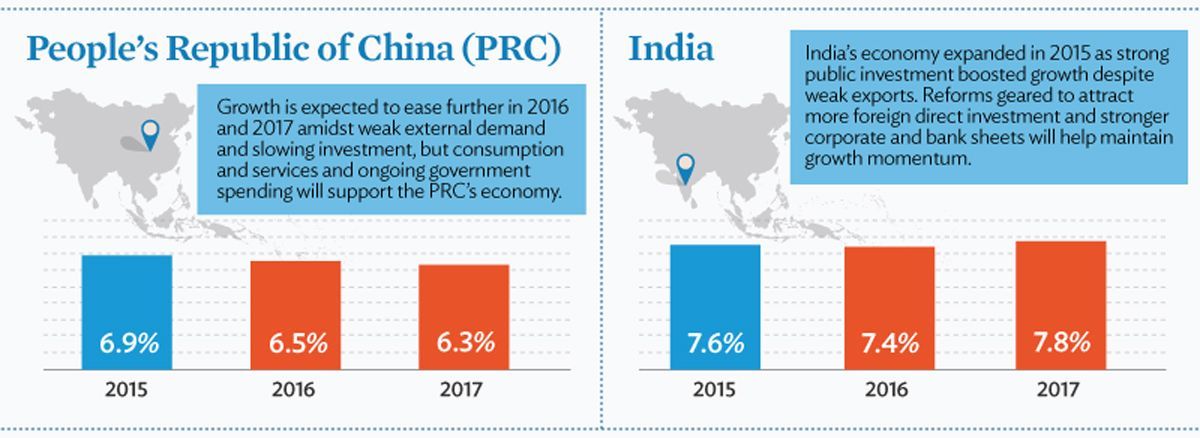
In 2017, growth will slow further to 6.3%. Due to its outsized linkages, estimates suggest the drag from the growth moderation in the PRC may be as much as 0.3 percentage points each year across the region.
Earlier this month the same ADB considered in a brief titled “Moderating growth and Structural Change in the People’s Republic of China ” that steep drop in growth in the PRC was not a high probability risk in either the short- or medium-term, as the PRC still has a number of policy options to offset shocks. If a much-worse-than-expected scenario should materialize, it could translate into a 1.8% decline in the rest of developing Asia’s growth.
Developed economies’ growth not further than 1.9%
Industrial economies’ growth will stay at 1.8% in 2016, before inching up to 1.9% in 2017. Stronger consumption and investment in the US will be tempered by soft external demand. Both the eurozone and Japan will see slightly improved prospects, the report said.
ADB downgrades its growth forecast for developing Asia, but no all countries negatively affected by PRC’s slowing economy
ADO forecasts gross domestic product (GDP) growth at 5.7% in 2016 and 2017 for the region as a whole. In 2015, GDP growth was 5.9%.
“PRC’s growth moderation and uneven global recovery are weighing down overall growth in Asia,” said ShangJin Wei, ADB’s Chief Economist. “Despite these pressures, the region will continue to contribute over 60% of total global growth. Countries across the region should continue to implement productivityenhancing reforms, investment in undersupplied infrastructure, and sound macroeconomic management to help increase their growth potential and insulate themselves from global instability.”
Despite this ADB pointed on 17th March this year in the brief titled “Moderating Growth and Structural Change in the People’s Republic of China” that no all of the countries included in the socalled developing Asia would be negatively affected by a slowing China. Anumber of Asian economies can benefit from the moderating growth and structural changes in the PRC economy, including such diverse countries as Bangladesh, Cambodia, India, Myanmar and Viet Nam.
These may see growth in industrial activity as the PRC withdraws from low-end segments of the manufacturing sector, including garments. In addition, countries and companies able to tap the steadily rising demand for goods and services by PRC consumers will also be in a good position going forward.
Soft global commodity prices and producer price deflation dual effect drivers in the region
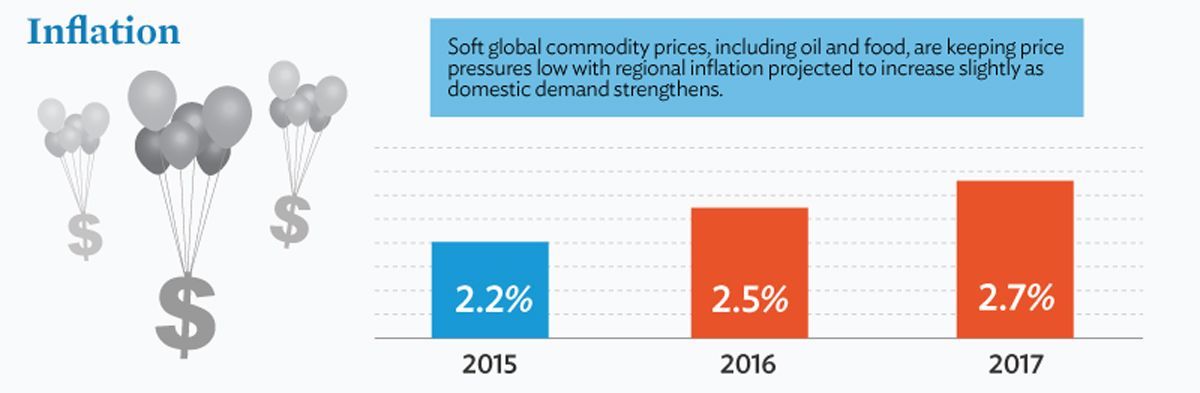
Soft global commodity prices, including oil and food, are keeping price pressures low with regional inflation projected to increase slightly to 2.5% in 2016, from 2.2% in 2015, as domestic demand strengthens. Inflation will reach 2.7% in 2017 as global commodity prices recover.
Subdued demand for exports of manufacturers and continued low commodity prices will trim developing Asia’s current account surplus from the equivalent of 2.9% of regional GDP in 2015 to 2.6% in 2016, and further to 2.4% in 2017.
Tepid oil and commodity prices will continue to dampen the prospects of Asia’s commoditydependent economies.
While consumer price inflation is generally low but positive, producer price deflation has emerged as a new risk in the PRC and other Asian economies, points ADB.
Other “headwinds” worsening the outlook: interest rate hikes in the USA and El Niño
Potential interest rate hikes by the US Federal Reserve combined with broader weakness of emerging markets mean that risks to the regional growth forecast remain tilted to the downside.
A sharpened investor risk aversion, alongside with an intensified global financial market volatility, and a heavier than forecast growth slowdown in the PRC would further weaken the global outlook and hurting exports and growth in Asia.
A sharpened investor risk aversion, alongside with an intensified global financial market volatility, and a heavier than forecast growth slowdown in the PRC would further weaken the global outlook and hurting exports and growth in Asia.
Leaving aside the economic threatens there are also some natural dissaster risks to be taken into account, such as El Niño weather cycle, a major climate risk for economies in the region that rely on agriculture.
Image over the headline.-
Related external links:
Asian Development Outlook (ADO) 2016
Asian Development Outlook (ADO) 2016 -infographic-
Image over the headline.-
Leaving aside India at the time of investing, the great mistake (I)
Leaving aside India at the time of investing, the great mistake (II)