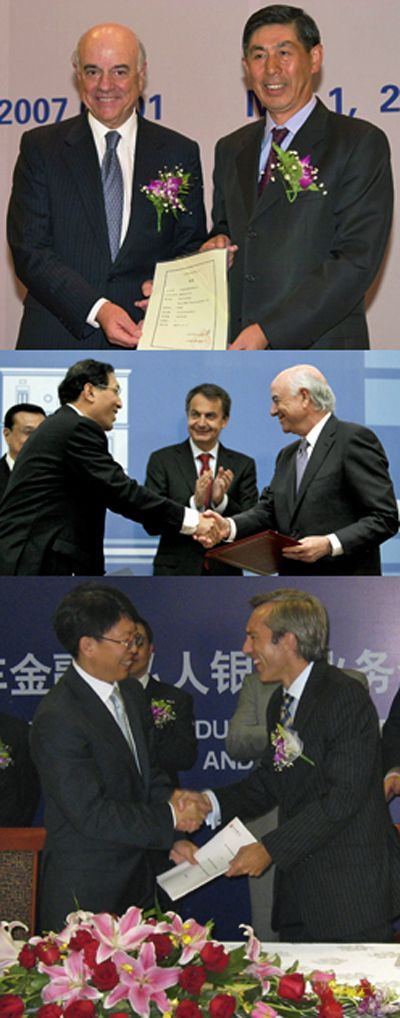
The Spanish bank, who is a shareholder of Citic International Financial Holdings (CIFH) and Citic Bank (CNCB) from 2007, grows now its share in the capital of the first mentioned Chinese financial entity up to a 30% (from a 15%) and in the capital of the second one to a 10.07% (from a 4%). BBVA has paid €800 million in the operation. But it is even more interesting than these achievements the strategic agreement signed with Citic Group, along with both the purchase of shares by the Spanish bank, and the total privatization of CIFH.
The Chinese government held a 30% share in the capital of this group.
According to the information provided by BBVA, the Spanish multinational finds particularly attractive the enormous although complicated Indian financial market. BBVA also expands slowly within the mature Japanese financial environment. The recent opening of a trade office in New Zealand offers the Spaniard bank a priviledged observatory with regard to a future expansion in this Asian country and, perhaps, in Australia.
BBVA and Citic Group have decided to seize their synergies, so that the Spanish company will begin its expansion in corporate and retail banking within Mainland China through CNCB.
The Spanish multinational will further carry out the entry and development of the corporate banking business in other Asian countries thanks to the Hong Kong based CKWB (Citic Ka Wah Bank Limited), another company belonging to the Citic Group.
The BBVA speaker who talked with eastwind referred specifically to Vietnam and Singapore, as potential areas for a future growth in Asia through CKWB. The opening of commercial offices in Continental China through CNCB is something that will be getting slowly in a medium and long term framework, says BBVA.
According to the information provided directly to Eastwind, the agreement signed with Citic Group is pending now only from some negotiations on the final price and from the aproval by the shareholders’ meeting of the Chinese group. The mentioned meeting will be held in August this year.
Under the agreement signed with Citic Group, BBVA maintains an option to purchase around an extra 5%, which allows the Spanish to increase the share in the capital equity of CNCB up to a 15% within the next two years.
Risk of default
About the increase in the share of BBVA in the capital of CNCB, Rafael Gil Tienda (Asia President of Marsh & McLennan Companies) expressed some prevention against this operation, within the conference organised by Asia Empresarial, held last 6th June at the Club Financiero Genova.
Tienda acknowledged that the Chinese banks had achieved to reduce the late payments and default rates from a level of the 15% and 25% to an average of a 5%.
Yet, the drop of this ratio has happened, as he assured, due more to an increase in the denominator, than because an actual decrease in the unpaid loans.
According to the data provided by the Asia President of Marsh & McLennan, with an annual increase of granted credits from a 20% to a 30%, the great problem that arises now is that the Chinese banks don’t perform an adequate analysis of the real risk of their loan portfolio.
As a result, it is not clear how many of them will become unpaid. Once adopted and executed the agreement between BBVA and Citic, “it must be seen, how good the portfolio of CNCB actually is”.
China and India compared, the expert underscored that the financial market in the country of the the Taj Mahal is much more healthy, but also much smaller.
CNBC closed its fiscal year 2007 with a profit of Yuan 8.290 Bn (4.560 Bn more than in 2006). It was the 7th Chinese bank in the field of loans last year.
According to the information published by EFE, CNCB plans to increase the granting of loans only around a 18% during 2008.
Gil Tienda was appointed Independent non Executive Director of CIFH on 1st December 2004.
The privatisation proposal communicated by Gloryshare Investments along with CIFH, which was published by the Hong Kong Exchange on 11th June this year, said that Tienda acts as advisor for the CIFH minority shareholders, option holders and bond holders, with regard to the approval of the scheme of arrangement and the privatization terms of the aforementioned holding company, in order to execute the agreement between BBVA and Citic Group.
Bridge towards Latin America
Pioneering in the expansion of Spanish banks within Latin America, the widespread presence of BBVA in the area may well increase Asian operations through BBVA towards this continent and vice versa.
José Ignacio Goirigolzarri, BBVA’s President and COO, stated during the conference “Investment in Latin America”, held last 19th June in Beijin: “Latin America and China complement each other. The former exports primary products and natural resources, while the latter exports industrial goods. This has prompted trade between both markets to soar in recent years”.
After an overview of the bank’s international expansion in Latin America,which has afforded it a presence in 13 countries there and made it a leader in the local markets, Goirigolzarri pointed : “BBVA is in an advantageous position, it has extensive experience and a team, which guarantees success whenever an investment in the region is carried out. In addition, our strategic partner CNCB has wide knowledge of local companies.
Therefore, the BBVA-CNCB tie up guarantees success for those Chinese companies looking to invest in Latin America”.
Looking for a suitable partner in India
Some BBVA branches and representative offices in China, Taiwan, India, Japan, Korea and Singapore, complement the agreement with Citic, from the point of view of the Spaniard bank’s presence in Asia.
BBVA launched a representative office in Mumbai at the end of 2007. The office accounts with just 10 people, all of them devoted to watch this domestic market and find the best way to begin BBVA’s expansion in the country.
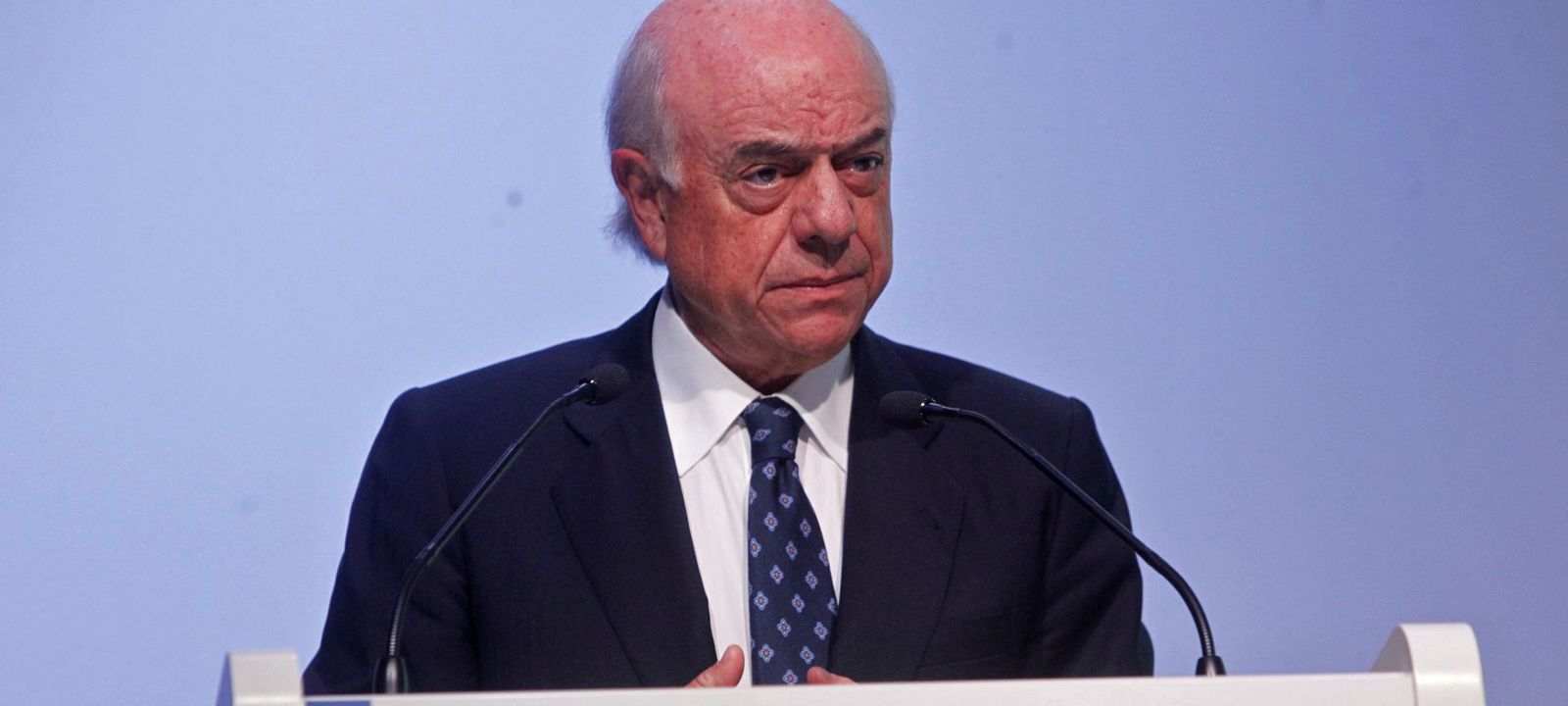
Francisco González (Chairman of the Group BBVA) recently stated in the conference titled “The Spanish Company’s International Expansion. Risks and Opportunities,” at the Menéndez Pelayo International University: “Asia is a source of enormous potential growth. But in order to create value there, we must be able to do business in a very different cultural environment and to learn from their great qualities and values.
This is the view at BBVA, and these principles of joint cooperation and learning are the ones that are guiding our expansion in Asia.
“An expansion in China and Southeast Asia, based on our strategic alliance with the CITIC group, which we will complement with independent ventures in India and other countries”.
The Spaniard group will not grow in India through CKWB, the plan is, either doing it alone, either through agreement with an adequate local partner.
Both options pose to BBVA legal barriers, which add to the complexity of the financial market within the Asian giant.
According to the information given to Eastwind by BBVA, a foreign bank can only open a maximum of 20 offices per year and the share in the capital of an Indian bank, which is allowed to be held by a foreign company is also restricted.
Image over the headline.- Francisco José González (President BBVA) and Kong Dan (President Citic) after inking the first agreement between both banks in 2007. © BBVA.