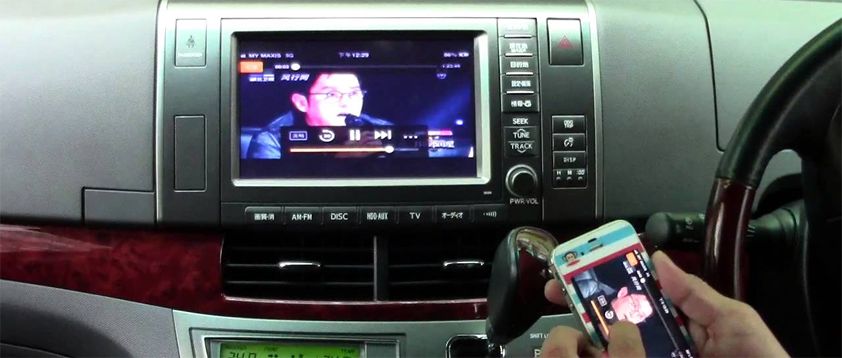
The project involved developing a trial voice ad service in collaboration with a company that offers a car navigation app with dictation function. The dictation function can be used as a chatbot and Dentsu made use of that dictation function to create a new chatting ad prototype.
How Dentsu chatting incar ads work
Chatting ads give information about items on sale based on external data sources.
They ask whether the route should be changed to go to the nearest store, and start the navigation once verbal confirmation is received from the driver.
For example, ads can recommend a housewife, who is driving on a weekday afternoon, recipes that are quick to cook and suggest buying ingredients for a stew or hot pot on a day that is far colder than the day before.
The external data included the date, the day’s weather and temperature, time zones, and information about the driver. Such data enable chatting ads to make recommendations.
That’s why ads can more effectively promote products by considering what the driver needs at opportune times.
2.3 times more likely to stop and enter a store, but might be seen as invasive
During testing, the app spoke over 30,000 times. The results showed that drivers who listened to the scripted chats, compared with those who didn’t, were about 2.3 times more likely to stop off at a store of the participating supermarket chain.
Despite this, “such a system can seem completely out of place and make people feel uncomfortable for any number of reasons. These include inappropriate dialogue content, poor timing, and unexpected responses. Great care should be taken with advertisements, since people generally dislike them.
“These concerns are not limited to car navigation systems, however. They are equally relevant to the communication design of smart speakers such as the Amazon Echo, Google Home, and Apple Homepod, as well as to LINE’s Clova Wave, all of which are expected to become more widely used in the future.
“I would like Dentsu to tackle these issues by taking advantage of the copywriting and communication design capabilities it has accumulated over many years.
Further, it is essential that Dentsu’s existing businesses, such as experience design, combine their expertise even in areas that might at first appear unrelated,” says Kazuya Kishimoto (Communication Designer Creative Planning Division 1).
Chatting incar ads may open an actual world of convenience
“In this project, we created a basic framework for a chatting ad service by carrying out our first trial. But we believe that future development projects would benefit from the following improvements,” points Kishimoto and mentions mainly three:integration of more external data for subtler suggestions;services with multiple clients for a more convenient platform; and ptimization of user service based on habits
1. Integration of more external data for subtler suggestions
The service Dentsu developed made talking suggestions based on information about each driver who registered to use the app, as well as the date and atmospheric temperature data.
In future, it will be possible to make subtler recommendations if Dentsu can access more information about drivers from data held by client companies or other sources.
For example, by integrating data on a driver’s purchasing history, the service could recommend a recipe using leftover vegetables purchased the previous day. Or it could remind the driver to buy toilet paper when the stock seems likely to be running low.
2. Services with multiple clients for a more convenient platform
Dentsu offered information about just one supermarket chain in the trial, but the agency can provide more news about goods on sale and increase convenience for drivers if many clients participate in the service.
Greater convenience will lead to more users, making the service seem more attractive to clients as a platform.
If this comens to happen Dentsu, as the platform provider, would need to coordinate the timing of the chatting ads and establish rules regarding repetitive content in order to gain the consent of each client.
3. Optimization of user service based on habits
Dentsu acquired logs of the uses of the participants during the testing phase.
But the trial was conducted over a short period, therefore recommendations by the chatting ads did not have much of an effect. Taking this into account there is a wide room to improve.
For example, for users who daily answer to chatting ads, it would be better to either switch to scripts that reduce the sense of communicative distance, or change the timing of the chatting ads to days and times when users are most likely to respond.
Image over the headline.- Toyota car connected through a mobile phone.