51% of CEOs in the Communications industry and 48% in Entertainment & Media expect to boost headcount inside their companies in the short term.
The percentage rises to the 59% among CEOs surveyed in the Tech industry.
Those are some of the outcomes from PwC’s 20th annual survey of CEOs confidence worldwide. The study has been presented today at the Davos Summit by Bob Moritz (elected as Global Chairman of PricewaterhouseCoopers International Network since July 2016).
The percentage of CEO’s planing job increases in Entertainment and Media has risen a 9% from 2016, but recovers just a 2% from the level surveyed for 2015 after the drop in a 7% experienced between 2015 and 2016.
The rise in the case of CEOs in the Communications industry reaches the 11% against 2015 and 9% between 206 and 2017.
Plans of hiring refrain in the Tech industry, where 59% of CEO respondents said they were going to boost the headcount this year against the 67% in 2016.
While still high, as the percentage is a 4% higher than in 2015, the level surveyed this year dorps from the 67% reached for 2016.
Despite the reduction in hiring intention in the Tech industry this sector is third in the ranking as relates to this point. Communications ranks 10th and Entertainment&Media gets the 13th spot.
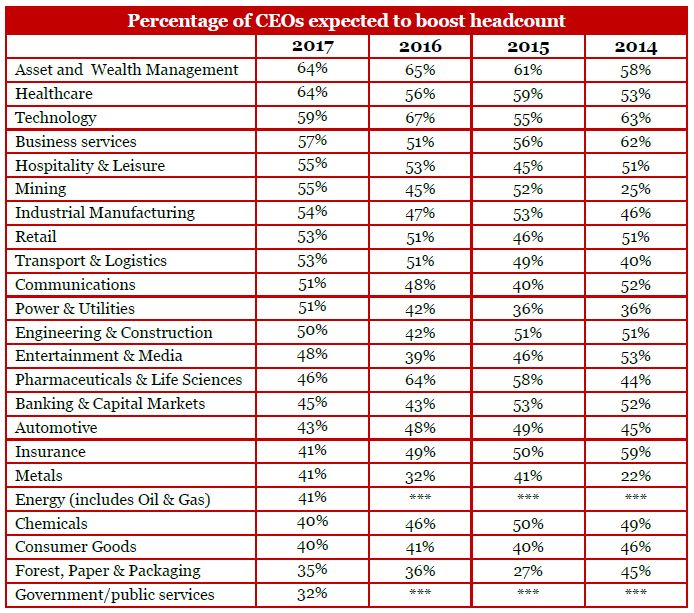
In general, over half of CEOs (52% vs 48% 2016) expect to increase headcount over next 12 months. The UK (63%), China (60%), India (67%) and Canada (64%) are amongst those with the most ambitious hiring plans. Looking by industry it is CEOs in the Asset Management (64%), Healthcare (64%) and Technology (59%) that have the most ambitious hiring plans, with CEOs in the Government and public sector (32%) having the least.
Concern about skills has more than doubled in 20 years
With the speed of technological change a concern for 70% of CEOs, it’s no surprise that skills in creativity and innovation, leadership and emotional intelligence are identified as the most valuable skills, that CEOs are finding it difficult to recruit. Digital and STEM skills are a recruitment issue for over half of business leaders (taking into account all CEos surveyed, not only in the Coomunications or Entertainment industries).
Over half of business leaders interviewed (52%) are already exploring the benefits of how humans and machines can work together, and two out five (39%) are considering the impact of artificial intelligence on future skills needs.
Bob Moritz, Global Chairman, PwC underscores:”CEO’s are concerned that key skill shortages will impair their company’s growth potential, relevance and sustainability. And it’s soft skills that they value the most. Innovation and relationship skills can’t be coded. So to drive the change CEOs need – thinking carefully and actioning accordingly – a balance between technology and irreplaceable skills in their people is key. Managing expectations with stakeholders will help enable the needed trust to survive and thrive. Bottom line – prioritizing the human element in a more virtual world will be a pre-requisite for future success.”
Concern about skills has more than doubled in 20 years (from 31% concerned in 1998 to 77% in 2017) and human capital is a top three business priority, with diversity and inclusiveness and workforce mobility amongst the strategies being used to address future skills needs. Skills availability is a concern for over three quarters (77%) of business leaders, and is highest for CEOs in Africa (80%), and Asia Pacific (82%).
Plans of hiring and skills concerns are just two among many other surveyed in PWC’s research.
Image over the headline.- RTVE employees at work. © RTVE
Related external links: