IBM has announced today that the company starts off the commercial launch of universal quantum computing systems. “IBM Q” quantum systems and services will be delivered via the IBM Cloud platform.
“Classical computers are extraordinarily powerful and will continue to advance and underpin everything we do in business and society. But there are many problems that will never be penetrated by a classical computer. To create knowledge from much greater depths of complexity, we need a quantum computer,” said Tom Rosamilia, senior vice president of IBM Systems. “We envision IBM Q systems working in concert with our portfolio of classical high-performance systems to address problems that are currently unsolvable, but hold tremendous untapped value.”
IBM sees practical applications of Quantum computing systems in the field of the supply chain & logistics, financial services, artificial intelligence, cloud security, drug and materials discovery and chemistry.
In addition to working with developers and universities, IBM has been engaging with industrial partners to explore the potential applications of quantum computers. Any organization interested in collaborating to explore quantum applications can apply for membership to the IBM Research Frontiers Institute, a consortium that develops and shares a portfolio of ground-breaking computing technologies and evaluates their business implications. Founding members of the Frontiers Institute include Samsung, JSR, Honda, Hitachi Metals, Canon, and Nagase.
As a first step to increase Quantum Volume -the new metric that express the power of a quantum computer -, IBM aims at constructing commercial IBM Q systems with circa 50 qubits in the next few years to demonstrate capabilities beyond today’s classical systems, and plans to collaborate with key industry partners to develop applications that exploit the quantum speedup of the systems.
This announcement is not the only one released by IBM and related to its quantum computing experience.
Many practical applications, also in the financial, logistics and marketing fields
While technologies that currently run on classical computers, such as Watson, can help find patterns and insights buried in vast amounts of existing data, quantum computers will deliver solutions to important problems where patterns cannot be seen because the data doesn’t exist and the possibilities that you need to explore to get to the answer are too enormous to ever be processed by classical computers.
IBM sees practical applications of Quantum computing systems in the field of the supply chain & logistics, financial services, artificial intelligence, cloud security, drug and materials discovery and chemistry.
In the AI sector, the tech giant considers there are interesting opportunities for quantum csystems in some facets of artificial intelligence such as machine learning much more powerful when data sets can be too big such as searching images or video.
In the financial services sector quantum computing systems are able to provide new ways to model financial data and isolate key global risk factors to make better investments.
Quantum computing systems can help as well in finding the optimal path across global systems of systems for ultra-efficient logistics and supply chains, such as optimizing fleet operations for deliveries during the holiday season.
One of the first and most promising applications for quantum computing will be in the area of chemistry. Even for simple molecules like caffeine, the number of quantum states in the molecule can be astoundingly large – so large that all the conventional computing memory and processing power scientists could ever build could not handle the problem.
Two further announcements
IBM has also announced today the release of a new API (Application Program Interface) for the IBM Quantum Experience and The release of an upgraded simulator on the IBM Quantum Experience.
The new API enables developers and programmers to begin building interfaces between its existing five quantum bit (qubit) cloud-based quantum computer and classical computers, without needing a deep background in quantum physics.

The upgraded simulator on the IBM Quantum Experience can model circuits with up to 20 qubits. In the first half of 2017, IBM plans to release a full SDK (Software Development Kit) on the IBM Quantum Experience for users to build simple quantum applications and software programs.
The IBM Quantum Experience enables anyone to connect to IBM’s quantum processor via the IBM Cloud, to run algorithms and experiments, work with the individual quantum bits, and explore tutorials and simulations around what might be possible with quantum computing.
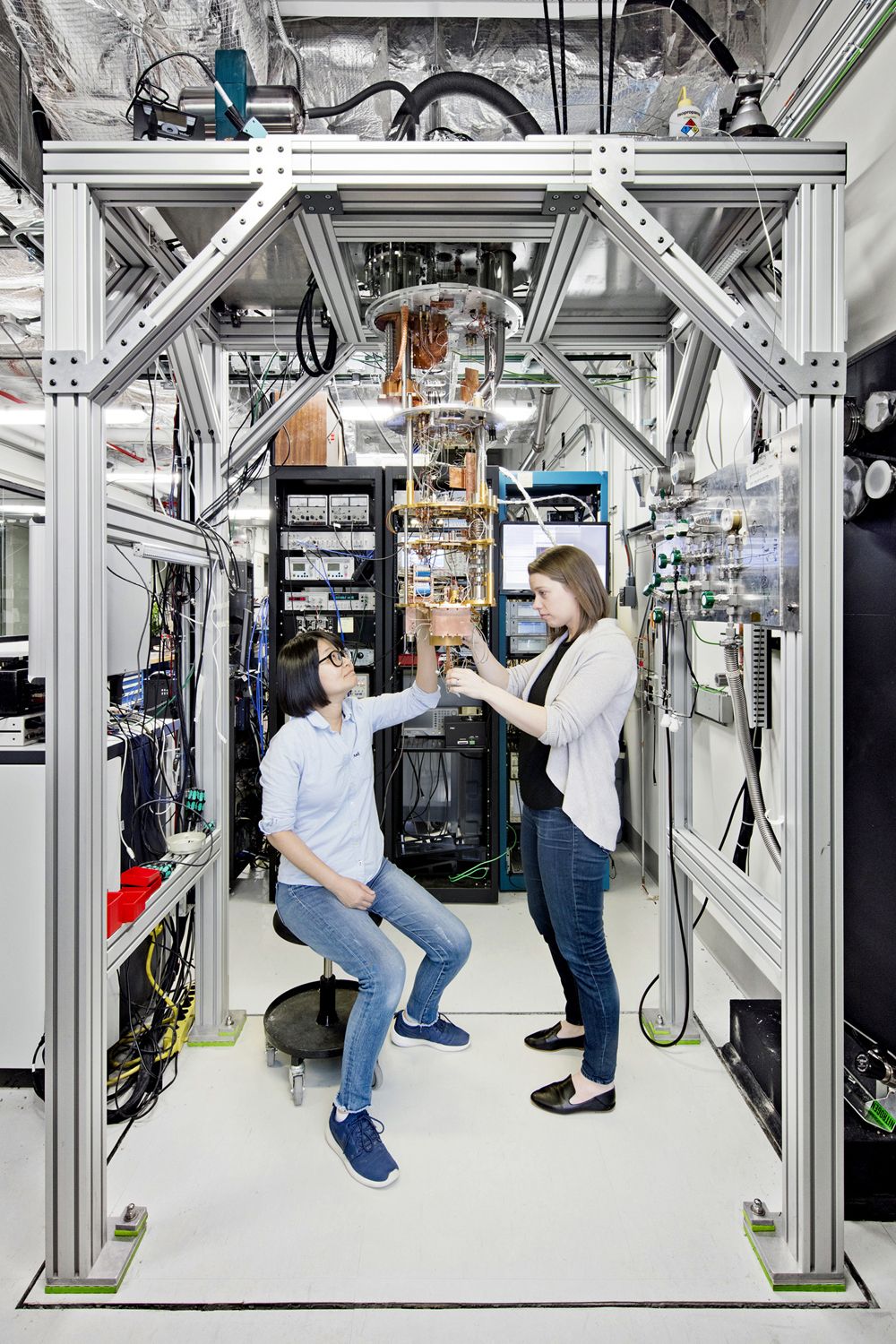
Image over the headline.- IBM Quantum Computing Scientists Hanhee Paik (left) and Sarah Sheldon (right) examine the hardware inside an open dilution fridge at the IBM Q Lab at IBM’s T. J. Watson Research Center in Yorktown, NY. Image by Connie Zhou for IBM.
Related Eastwindmarketing links:
IBM first quantum computing platform available to the public
IBM starts commercialising universal quantum computing systems (video)