In the European Union (EU), 8.2 million persons were employed in 2016 as Information and Communication Technologies (ICT) specialists, representing 3.7% of total employment. Over recent years, both the number and the share of ICT specialists in total employment have continuously risen to better adapt to an ever digitalised world.
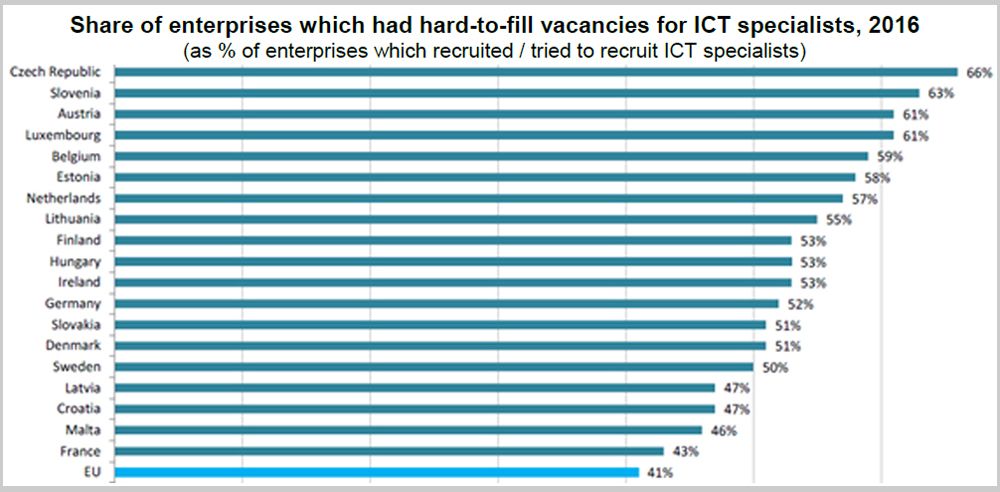
One in five companies in the EU (20%) employed ICT specialists and nearly one in ten (9%) recruited or tried to recruit ICT specialists. However, 41% of enterprises which recruited or tried to recruit ICT specialists had difficulties in filling vacancies.
All the data mentioned above come from the latest report on this point issued by Eurostat, the statistical office of the European Union.
Eight in ten jobs filled with male candidates with tertiary education levels
This profession is largely made up of men, accounting in 2016 for more than 8 out of 10 ICT specialists employed in the EU (83.3%), and of highly educated people, with more than 6 in 10 ICT specialists (61.8%) having a tertiary education or higher.
Women are under-represented among ICT specialists in all EU Member States, a striking contrast with total employment, where the genders are broadly balanced. Figures show that in 2016, an overwhelming majority (83.3%) of ICT specialists employed in the EU were men. This was the case in every EU Member State. The highest shares of male ICT specialists were observed in Slovakia (90.8%), the Czech Republic (88.8%), Malta (88.3%), Greece (87.3%), Hungary (86.9%) and Croatia (86.7%), while Bulgaria (69.8%), Romania (73.7%), Latvia and Lithuania (both 75.2%) recorded the lowest.
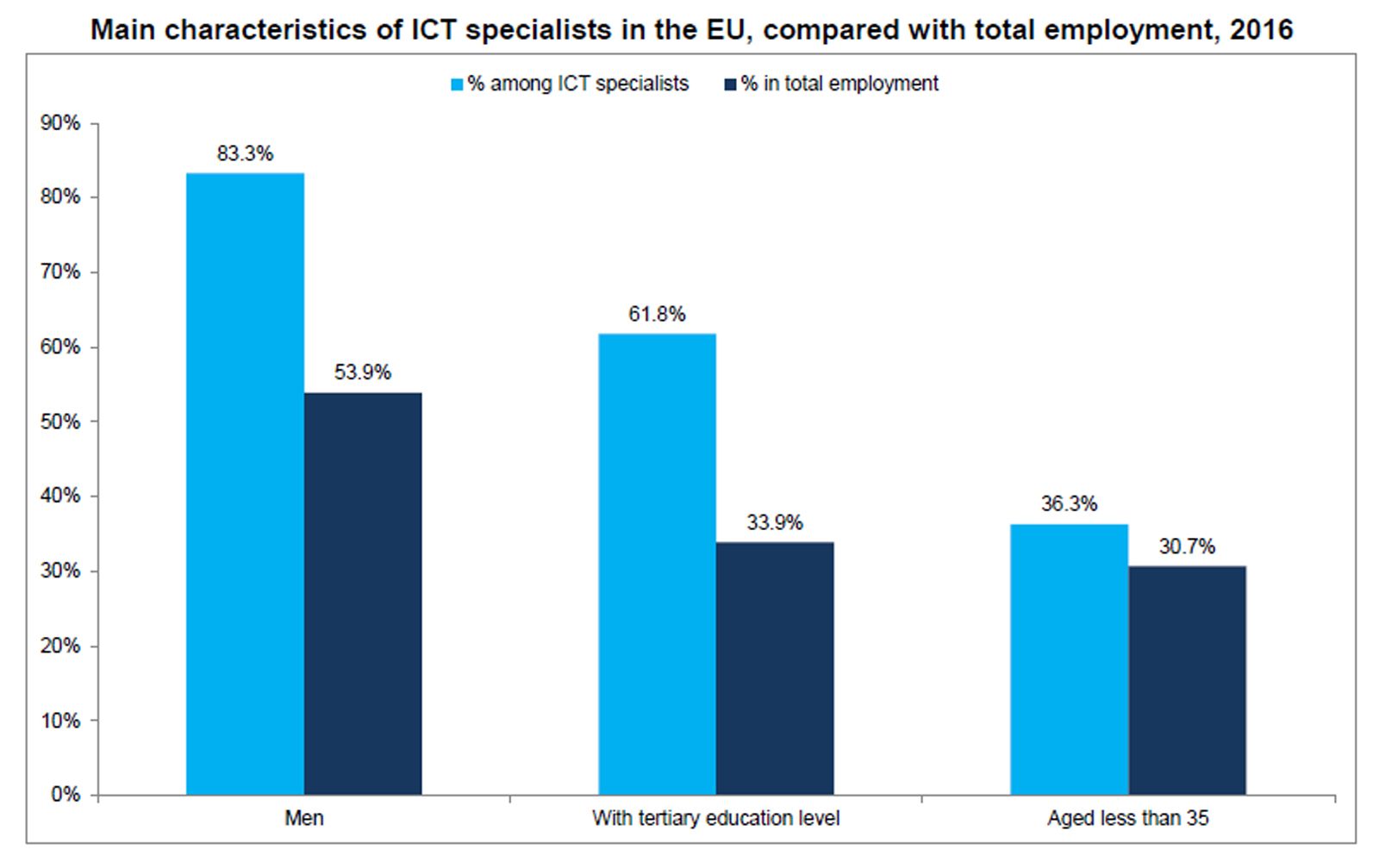
In the EU in 2016, 6 in 10 (61.8%) ICT specialists had a tertiary education level. The highest proportions were registered in Ireland (82.4%) and Lithuania (80.7%), ahead of Spain (79.1%), France (78.4%) and Belgium (76.2%). At the opposite end of the scale, the lowest proportions of ICT specialists having completed tertiary education were recorded in Italy (32.8%), followed by Germany (49.6%), Portugal (51.2%) and Croatia (52.5%).
In 2016, the share of employed persons with tertiary education was higher among ICT specialists than in total employment in all EU Member States.
Younger than 35 years old
In 2016, there were proportionally more persons younger than 35 among ICT specialists than in total employment in a majority of Member States, with the exceptions of Denmark, Finland, Sweden, the Netherlands, Luxembourg and the United Kingdom.
In 2016, more than 1 out of 3 ICT specialists (36.3%) in the EU was younger than 35. Across Member States, the majority of ICT specialists employed were younger than 35 in Malta (63.1%), Latvia (54.1%), Poland (53.6%) and Lithuania (50.2%). In contrast, persons younger than 35 accounted for fewer than a third of all ICT specialists employed in Italy (24.5%) and the three EU Nordic Member States: Finland (28.6%), Sweden (30.0%) and Denmark (30.4%).
Over 41% of companies reported hard-to-fill vacancies
In the EU in 2016, 41% of enterprises which recruited or tried to recruit ICT specialists reported hard-to-fill vacancies.
The highest percentages were recorded in the Czech Republic (66% of enterprises which recruited or tried to recruit ICT specialists), followed by Slovenia (63%), Luxembourg and Austria (both 61%), Belgium (59%), Estonia (58%) and the Netherlands (57%). In contrast, this share was lowest in Spain (17%), Greece (28%), Poland and Italy (both 31%) as well as Portugal (32%).
Image over the headline.- © Eurostat
Related external links: