
Comparing to 2017, the growth of loses that fraudsters have caused to marketers has reached a skyrocketing number of $3.9Bn, with a 22% of all traffic both mobile and web being fraudulent. Comparing mobile ad fraud statistics for 2017 and 2018 FraudScore report shows that the numbers almost doubled.
While attribution fraud was the most widespread fraud type on the market the year before last. Click-spamming and click-injection were the leading fraud tactics FraudScore detected in 2017. Despite this, the foretell for 2018 made in the 2017 report was that smart bots would take the leading fraud-generating positions.
Now FraudScore research shows that 2018 has been a year of botnets. Each time one check there’s more and more sophisticated malware. In a matter of days, these bots are implanted in thousands of devices to exploit profitable ad campaigns amongst other malicious purposes.
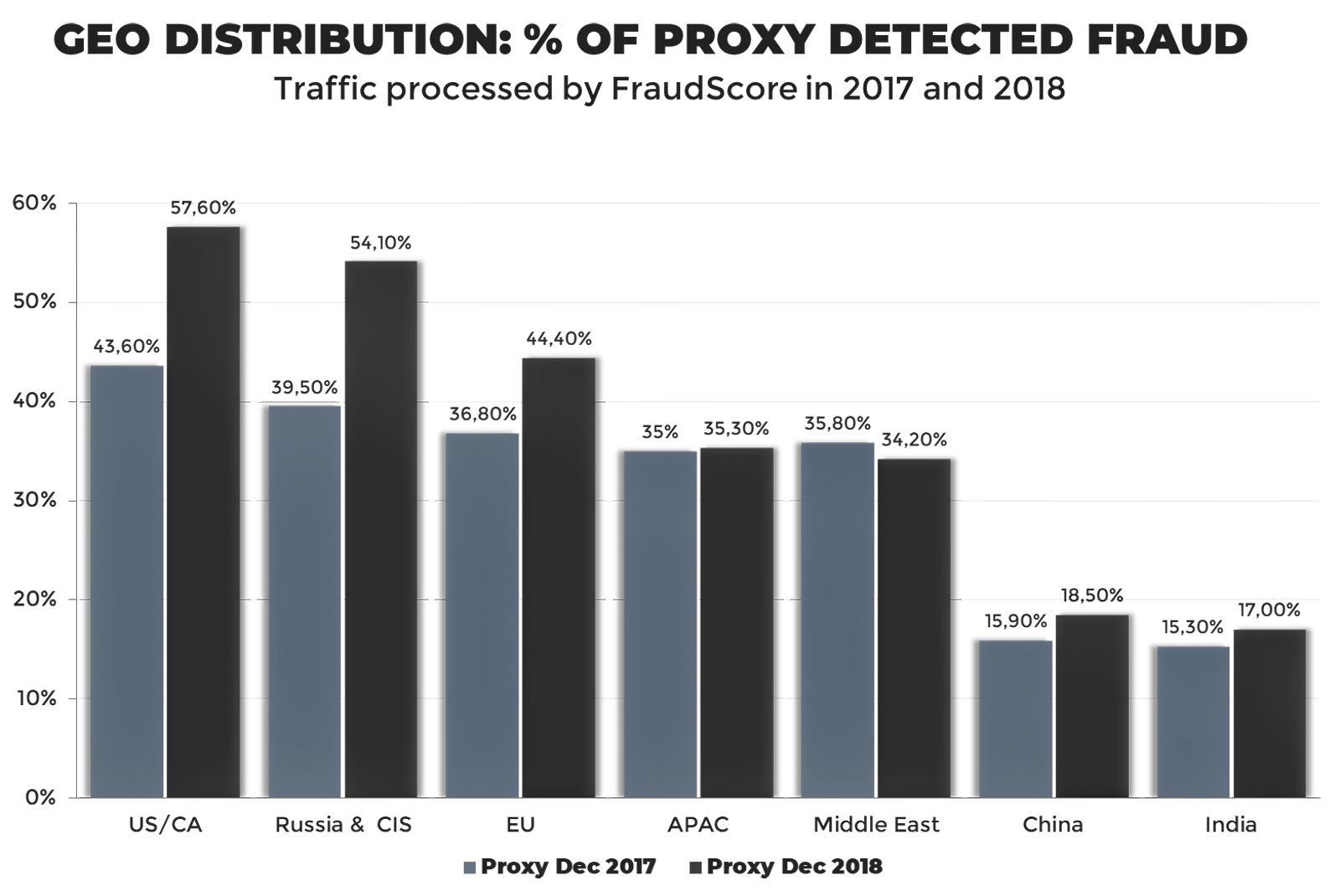
FraudScore statistics estimate that in 2018 Proxy fraud, one of the symptoms of bots, has increased by 1.5% in mobile traffic compared to 2017, with US/CA at the head (57.60% share in this field in 2018 against the 43.60% in 2017). They follow Russia&CIS, EU, APAC region, Middle East, China and India.
Seven types of digital ad fraud monitored
The report controlsl seven tipes of digital ad fraud: Detected proxy; Device Software Anomalies; IP distribution anomalies; Suspicious attribution; Datacenter IP; Device abnormalities; and Bad source.

Detected proxy, – all violations identified by IP addresses in conjunction with other parameters of conversion: botnets IPs, adware IPs, false GEO, traffic from proxy devices or networks etc.
Device Software Anomalies .- detected abnormal device distribution: device models, browser versions, operating system, etc.
IP distribution anomalies. – violation identified by IP abnormalities: multiple conversions from the same IP or the same IP subnet
Suspicious attribution. – click spamming, cookie stuffing, click injection, etc. This includes all kinds of fraudulent activities aimed to steal organic conversions
Datacenter IP. – traffic that originates from data centers servers or known cloud platform providers
Device abnormalities .- all violation that are identified by abnormal device parameters: device emulators, fake device user agents, IDFA/Android IDs, MAC addresses etc.
Bad source .- all that identifies fraud traffic sources: suspicious web sites, source traffic differs from the declared source etc.
Image over the headline.- © FraudScore
Related external links: