
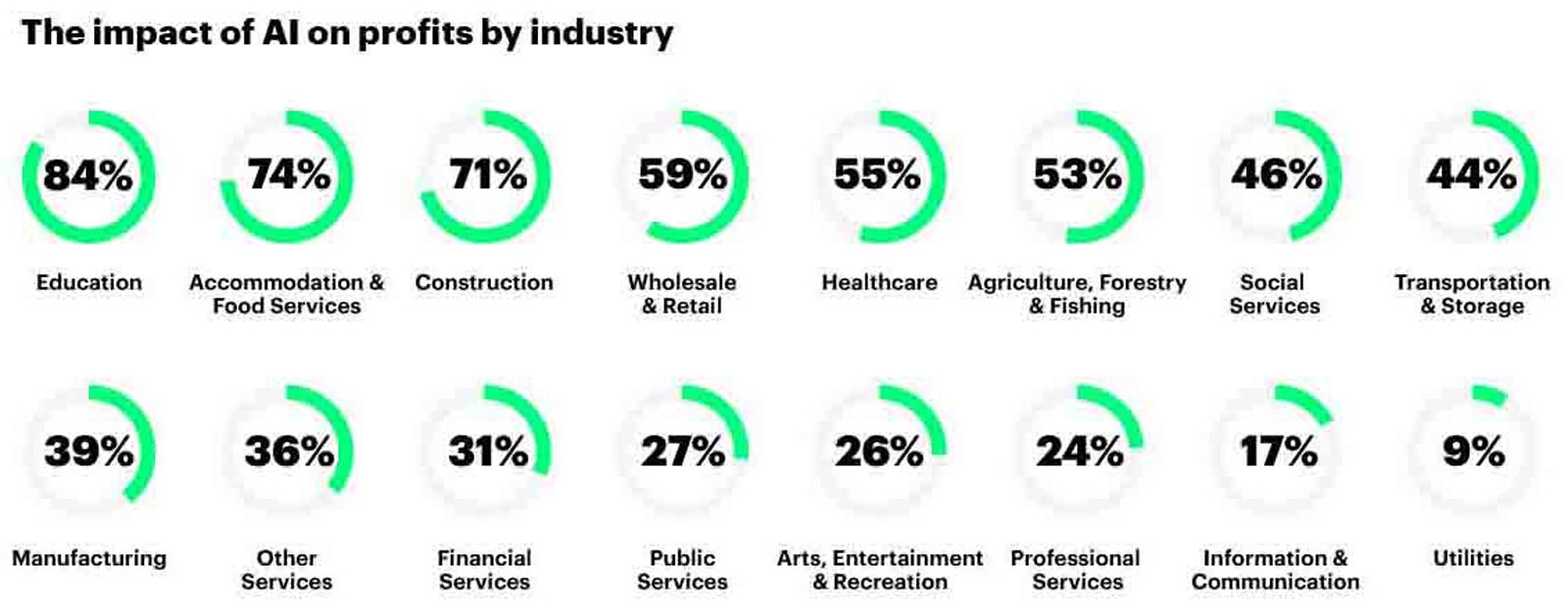
Businesses that successfully apply artificial intelligence (AI) could increase profitability by an average of 38% by 2035, according to a new report from Accenture.
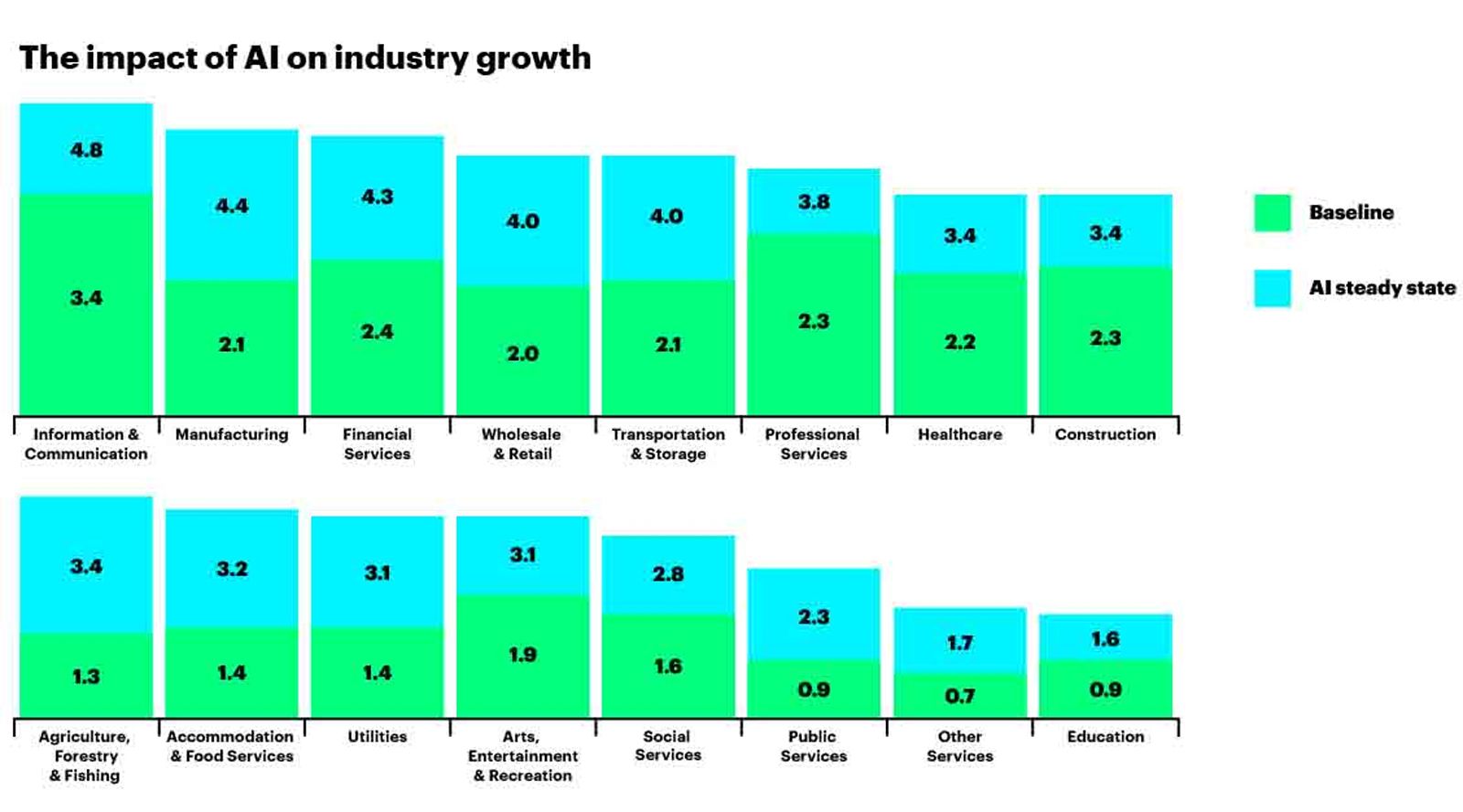
Regarding the Information and Communication sector, the mentioned increase of profits is expected by Accenture at around the 17%, compared to the rest of industries considered in the research. The impact of AI on growth for the mentioned sector is expected to be a 4.8% over a baseline of 3.4%, the highest in absolute terms.
The introduction of AI could lead to an economic boost of $14 trillion in additional gross value added (GVA) across 16 industries in 12 economies.
The report identifies eight key strategies for successfully implementing AI that focus on adopting a human-centric approach and taking bold and responsible steps to applying the technology within businesses and organizations.
This research builds on the Why Artificial Intelligence is the Future of Growth report released in 2016 that examined the economic impact of AI across 12 developed economies. The report found that AI could double annual economic growth rates by 2035 and boost labor productivity by up to 40 percent by fundamentally changing the way work is done.
To prepare for a successful future with AI, business leaders should consider the following eight strategies, says the report:
1.- AI strategy and leadership: Attaining value from AI will demand recognition and action from the top of the company; therefore, the benefits must be made tangible to the C-suite and a roadmap is essential.
2.- Reinvent HR -human resources- into HAIR: The Chief HR Officer’s role will not only be about managing human employees, but will evolve to also manage human-machine interaction, or Human AI Resources (HAIR).
3.- Learn with machines: To adapt their businesses to the changing nature of learning and employee training, business leaders must focus on the needs of their workforces, particularly in the area of agile skills development.
4.- Appoint a chief data supply chain officer: This position will be needed to construct an integrated, end-to-end data supply chain.
5.- Create an open AI culture: Trust, openness and transparency are key for human and machine relationships to work well; business leaders must shape the corporate culture and guidelines to minimize the risks of a hybrid workforce while maximizing the opportunities.
6.- Take the crowd into the cloud: The next phase of innovation will combine crowd-sourced data in the cloud with AI capabilities to create new and disruptive business opportunities.
7.- Step beyond automation: With recent strides in AI, companies need to take a step beyond to harness the intelligence of dynamic, self-learning and self-governing machines.
8.- Measure your return on algorithms: Unlike traditional assets that depreciate over time, AI assets gain value as time passes so CFOs will need new financial metrics to properly assess the “Return on AI,” which could include the value generated from each algorithm or a combination of initial outlay and ongoing costs.
“Artificial intelligence will revolutionize how businesses compete and grow, representing an entirely new factor of production that can ignite corporate profitability,” said Paul Daugherty, Chief Technology & Innovation Officer, Accenture. “To realize this significant opportunity, it’s critical that businesses act now to develop strategies around AI that put people at the center, and commit to develop responsible AI systems that are aligned to moral and ethical values that will drive positive outcomes and empower people to do what they do best: imagine, create and innovate.”
The report, developed by Accenture Research in collaboration with Frontier Economics, measures the potential economic impact of AI in GVA, a close approximation of gross domestic product that accounts for the value of goods and services produced.
“By exploring the macroeconomic impact of AI as it matures over the next few decades, it’s clear that organizations in every industry have tremendous opportunities to apply AI to unleash remarkable benefits,” said Mark Purdy, Managing Director, Accenture Research. “By optimizing processes with intelligent automation, augmenting human labor and physical capital, and propelling new innovations, AI can drive dramatic and long lasting profitability and economic growth.”
Image over the headline.- © Accenture.
Related External links:
To access the How AI Boosts Industry Profits and Innovation report, click here
Why Artificial Intelligence is the Future of Growth