Yesterday YouTube introduced its new CPM pricing system in You Tube TrueView video ad format. Several media have aired the news as a true advance in programatic trading, but today I think we should remember some true problems in this field that are not solved with You Tube’s CPM pricing system for skyppable ads.
Latest WARC Global Ad Trends report says that 320 in each 1000 clicks are not real clicks in programatic ads, or what is the same the fraud reaches the 32%.
The report adds that aside from fraudulent impressions, click fraud is also prevalent online. Data show that as many as three in four clicks on programmatically purchased 300 x 600 ‘half page’ ads (a unit Google describes as one the fastest growing sizes) are fraudulent. On average, one in three clicks on programmatic ads across all sizes and platforms is not real.
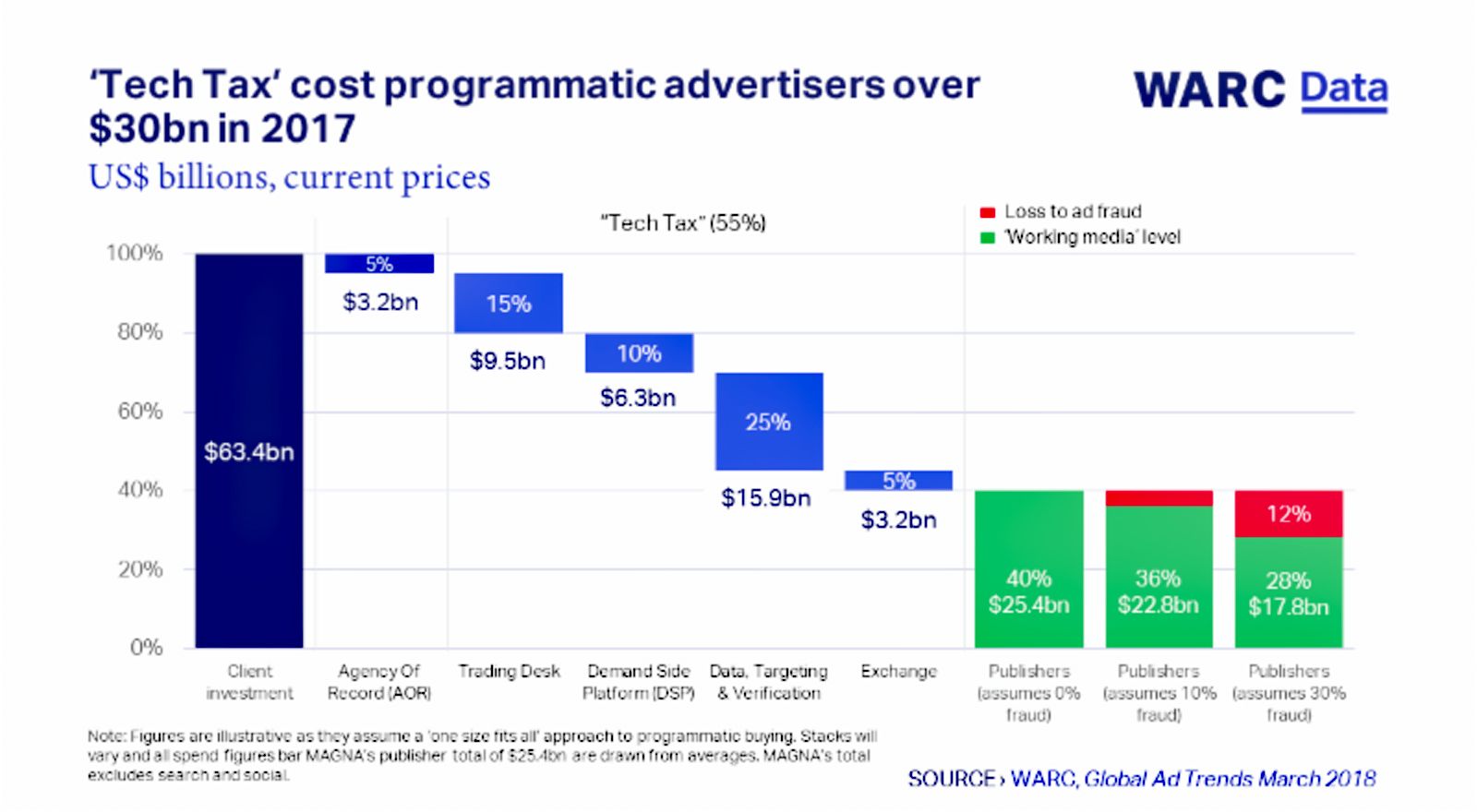
WARC report is crystal clear: After agency fees, of the $63.4Bn in estimated programmatic advertiser spend last year, only $17.8Bn made it to the ‘working media’ level when assuming a 30% fraud rate.
Ad misplacement risk
Leaving aside the ad fraud issue there are other risks that still remain unsolved, such as negative adjacency ( ad misplacement) that with programmatic stays at 11%. And something worth to take note, almost a 20% of consumers would take direct action against a brand if its advertising appeared alongside objectionable content, either by boycotting the brand (10.5%) or being vocal/raising issue (9.0%).
What’s more, WARC report underscores that 43% of senior marketers claim that they have already had reputation problems after ads had appeared next to objectionable content. Almost two in five (37%) have pulled or intend to pull ads as a result.
Tech tax exceeding the 50%
Besides, The World Federation of Advertisers (WFA) and WARC estimates the rate of ‘tech tax’ (the money spent on trading desks, demand side platforms, ad exchanges and data, targeting and verification services) within the programatic chain exceeds the 50%, infact bothe estimates it at a 55%. Assuming this proportion the tech tax would equate to $34.9Bn.

WARC estimates the true figure will be closer to $30Bn, as platforms where the tech is integrated (such as YouTube’s TrueView) cloud the calculation.
“The boom in programmatic advertising over recent years has exposed major flaws in the ecosystem, including heightened brand risk, impression and click fraud, and poor viewability and dwell time. This has led advertisers, who collectively paid $30bn to ‘middlemen’ in the online ad supply chain last year, to reassess the way they invest and keep pressure on the industry to clean up its act,”James McDonald (Data Editor, WARC) points.
As we said before WARC estimates that $63.4Bn was spent on programmatic advertising worldwide last year, but as little as $17.8Bn (28%) may have actually made it to the ‘working media’ level. And this is something to think about, not only for advertisers but from the point of view of fair competition in the media side, specially when one considers that following WARC report a 46% of programmatic ads do not meet Media Ratings Council standard; that there’s a 8% average fraud rate for non-optimised programmatic ads; and that just a 23% of viewable desktop ads are actually seen.
I have mentioned above YouTube, but the report does not leave aside ad fraud in Facebook, where WARC estimates that 13% of accounts are worthless for advertisers.
A 10% of Facebook’s 2Bn monthly users are duplicate accounts, according to company reports. The number of fake accounts is estimated to be between 2-3% by Facebook, suggesting that as many as 265 million accounts could be worthless to advertisers.
Going deeper in Social Media ad fraud, WARC says that separate research shows that on average, 16.4% of the followers on Instagram’s top 20 accounts are fraudulent and as many as 15% (49 million) of Twitter’s users don’t have an offline identity.
Image over the headline.- WARC logo. © WARC.