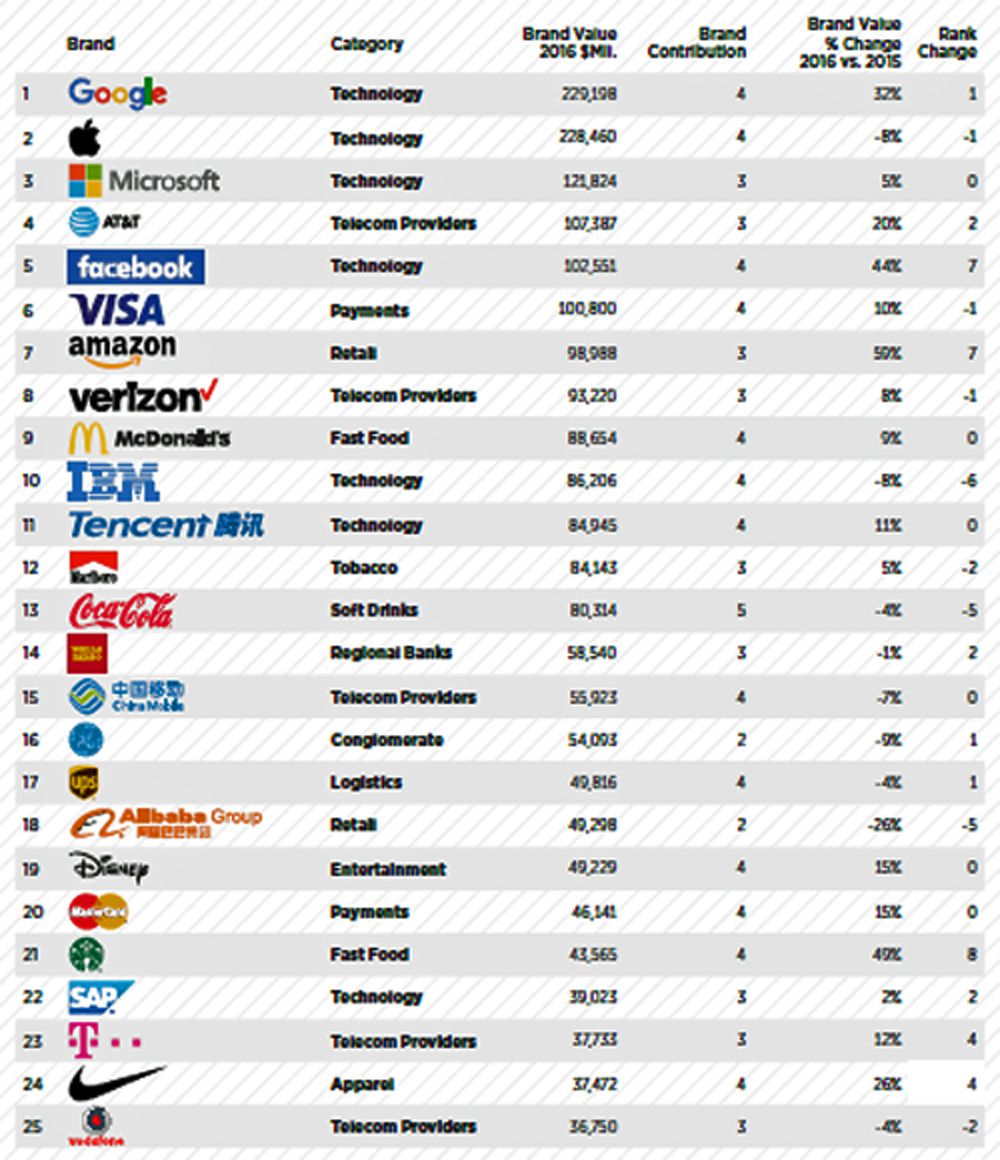
Continual innovation, increased revenue from advertising, and growth in its cloud business has helped Google leapfrogg Apple taking the no.1 position in the 2016 BrandZTM Top 100 Most Valuable Global Brands ranking, released today by WPP and Millward Brown.
The brand increased its value 32% to $229Bn, while last year’s leader Apple dropped to no.2 after declining -8% in value to $228Bn.

“The value of the BrandZ™ Top 100 Most Valuable Global Brands has increased steadily over the past 11 years, rising 133% between 2006 and 2016, despite fluctuations during and immediately after the global financial crisis,” says David Roth, CEO, The Store WPP, EMEA & Asia, and continues, “…This pattern of reliable growth, modulated by global economic and geopolitical forces, continued with 2016 BrandZ™ Global Top 100, which rose 3% in brand value in a year marked by a historic plummet in oil prices and slower economic growth in Brazil and Russia, and even China, where GDP expansion slackened relative to the robust rates of a few years ago.”
“These factors especially impacted the oil and gas, and the banks categories. Absent those categories, the BrandZ™ Global Top 100 improved around 6%”, he underscores.
All together the group of the Top 100 most valued brands reached the $3.4 trillion mark.
Only tech and telecom giants in the top 5 group
Leaving aside Google and Facebook, there is another tech giant and a telecom giant in the Top 5 group.
Microsoft remains at no.3, growing 5% to $122Bn, while Facebook (+44%, no.5) and AT&T (+20%, nº.4).
Another tech company but operating in the e-commerce field, Amazon (+59%, no.7) entered the Top 10 for the first time, while the Chinese Alibaba loses 26% value with a 5 spot drop to the 18th position.
Disruption, a catalyst for value growth and innovation, the main growth driver
“The brands that thrive, regardless of sector, are those that behave like challengers and adopt disruptor models and mindsets,” said David Roth, CEO EMEA and Asia, The Store WPP. “They’re shaking up other categories with innovation that goes beyond new products or technologies, transforming the way a service is delivered, enhancing the consumer experience or changing a format. The power these brands already hold, combined with the strength of their platforms, is enabling them to quickly and successfully move across sectors.”
Disruption was the dominant trend, with brands changing the status quo with their offerings in a number of ways, often beyond the use of digital technologies. Brands of all kinds moved to build a multi-faceted ecosystem around the consumer’s needs and desires, often by diversifying into new categories. Amazon built its own logistics network using independent contractors, which enabled it to offer flexible and one-hour delivery options, and started producing its own content. Facebook began hosting publishers’ original content to keep members active.
Starbucks (+49%, no.21) moved into the ecommerce space with a ‘tap and go’ app, and enhanced its cold drinks and savoury ranges and offered beer and wine to extend its relevance.
The categories that increased in value were all either shaken up by challenger brands founded on a unique and meaningful proposition, such as Under Armour and Victoria’s Secret in the apparel category (+14%), or innovated to a high degree in response to a new trend, such as the brands in the fast food category (+11%) which successfully responded to global demand for healthier products.
Further more, disruption extends to the ranking itself. Close to half (46) of the brands in the 2016 Top 100 entered the ranking after it was first launched in 2006; 54 have been there since the inaugural ranking. This shows how a strong brand can sustain its value over time, but also illustrates the potential that exists for new brands to successfully shake up the status quo.
Innovation is the main growth driver, but it must be seen and felt by consumers. The brands that are the strongest innovators have increased their value the most over the 11 years of BrandZ Top 100 rankings. However, to have an impact on brand value, innovation must be clearly communicated and delivered through the brand experience. the brands that are perceived as innovative by consumers include Disney (no.19) and Pampers (no.37). Both grew nine times faster than those seen as less innovative.
Doreen Wang, Millward Brown’s Global Head of BrandZ, comments: “By stretching their brands in innovative ways and expanding into new categories, the strongest brands in the Top 100 are increasing their penetration and their relevance in people’s day-to-day lives. There is a risk in doing this, however: it blurs the lines between categories and can leave brands struggling for identity. Defining and articulating a very clear positioning and purpose will play a more crucial part than ever in building a strong, distinct brand.”
Emotional connection the winning feature for local brands
Strong emotional connections are boosting local brands. With a clear understanding of their consumers’ needs, local brands are gaining market share at home and, with improved functionality and marketing, are also winning share in new regions. China’s Huawei (no.50, +22%), for example, has rapidly globalised and taken market share from both Apple and Samsung.
Strong brands outperform the market. Brands that appear in the BrandZ Top 100 Most Valuable Global Brands ranking consistently deliver a better financial performance than brands that are not included, thereby generating a superior return for shareholders.
Leading days for Coca-Cola seem gone by and Chinese brands stagnate or go down in general
Coca-Cola, that not many years ago used to lead the ranking gets the 13th spot valued at $80.314Bn a 4% drop fom 2015 and going down 5 positions in the ranking.
Still no Chinese brand in the 10 head group, but Tencent (84.945Bn and 11% value growth) remains in the 11th spot.
China Mobile (telecom) and Alibaba Group (retail), the other two Chinese brands within the 20 most valued in the world both experinece drops in value (7% and 26% respectively, compared to that obtained in 2015). The decrease in value translate in a drop down in the ranking just for Alibaba, that goes down 5 spots to the 18th position. China Mobile keeps the 15th spot.
Focus on B2B brands, a first inthe BrandZ report
“B2B brands score well above average in all aspects of Brand Potential, a BrandZ™ metric that predicts future brand success. But they have a large opportunity to reach the Brand Potential levels of business-toconsumer brands”, says David Roth, CEO, The Store WPP, EMEA & Asia
Image over the headline.- © Millward Brown
Related external links:
2016 BrandZTM Top 100 Most Valuable Global Brands ranking report