“I am not interested in issuing ultimatums or turning my face while I demand others sort this out. I prefer to be part of the solution. At Unilever we believe we are as strong as our partners, as our supply chain. If they succeed, we will succeed with them. And in the same way that we have taken a positive stance with our supply chain across all our products, committing to sourcing all our agricultural raw materials sustainably by 2020, we have been taking a positive stance with our digital supply chain”, Keith Weed Unilever’s CMO, at the IAB Annual Leadership Meeting in Palm Desert.
Weed, has called on the industry to collectively build trust back into our systems and society; and announced a new commitment to cut investment in platforms which breed division or not complying with the 3Vs and social responsibility requirements for their digital suppliers.
Unilever plans $8.4Bn brand and marketing total investment in 2018
Paul Polman (CEO Unilever) informed that the absolute level of brand and marketing investment during the 2017 fiscal year was flat in local currencies versus the prior year, as savings in advertising production were re-invested in increased media spend, particularly in the second half of the year. As a percentage of turnover, brand and marketing investment was down 60bpslast year.

In 2016 total marketing investment by Unilever totalled €7,731 million, down from €8,803 million in 2015.
As unveiled by Keith Weed there are plans to invest around $8.4 (€7.7Bn) in the brand and marketing chapter this year.
Once reached the he 3Vs
“At Unilever we have been clear and consistent over the past three years about what we consider the minimum standards to be, across the 3 Vs of viewability, verification and value, and that consistency has delivered results. In viewability we have established and implemented industry leading viewability standards, including working with Group M and others on a new display news feed standard, and we are in the final stages of research to establish news feed video standards.
“For verification, we are successfully working with third party to verify our media across all platforms across the globe. All leading to greater value from our media spend. Our position here has not changed. And there is still more to do. But ultimately, these are table stakes.
Unilever adds responsibility requirements in three fields
“And it is acutely clear from the groundswell of consumer voices over recent months that people are becoming increasingly concerned about the impact of digital on wellbeing, on democracy – and on truth itself. This is not something that can brushed aside or ignored. Consumers are also demanding platforms which make a positive contribution to society,” underlined Keith Weed Unilever’s CMO.
Ad he continued: “Social media should build social responsibility. So it is in this context that, as one of the world’s largest advertisers, I make these three commitments here today, about Unilever’s digital media supply chain. It’s time to change the conversation.

“Firstly, responsible platforms. Our commitment: Unilever will not invest in platforms or environments that do not protect our children or which create division in society, and promote anger or hate. We will prioritise investing only in responsible platforms that are committed to creating a positive impact in society.
“Secondly, responsible content. Unilever is committed to creating responsible content, initially tackling gender stereotypes in advertising through #Unstereotype, and championing this across the industry through the #Unstereotype Alliance.
“And finally, responsible infrastructure. Unilever will only partner with organisations which are committed to creating better

digital infrastructure, such as aligning around one measurement system and improving the consumer experience.
A matter of sustainability
“Fake news, racism, sexism, terrorists spreading messages of hate, toxic content directed at children – parts of the internet we have ended up with is a million miles from where we thought it would take us. It is in the digital media industry’s interest to listen and act on this. Before viewers stop viewing, advertisers stop advertising and publishers stop publishing.” added Weed.
“Across the world, dramatic shifts are taking place in people’s trust, particularly in media. We are seeing a critical separation of how people trust social media and more ‘traditional’ media. In the US only less than a third of people now trust social media (30%), whilst almost two thirds trust traditional media (58%).
“Just because one is physical and one is virtual, they are still absolutely part of our value chain. And we cannot continue to prop up a digital supply chain (one that delivers over a quarter of our advertising to our consumers) which at times is little better than a swamp in terms of its transparency.
“We have spent a lot of effort building a business on sustainability. Our future strategy is based on the fact that consumers care about this, and will increasingly so. We can no longer continue to meet the values of one while holding the other at arm’s length. If we are committed to making our supply chains sustainable, that is all of our supply chains. And the current digital supply chain is far from being sustainable,” Keith Weed Unilever’s CMO cloncluded.
Following the data published by Business Insider in June 2017, Unilever, inserted ads on 606 sites between January and May 2016, with a 11% drop during the same period in 2017 to the 540 sites.There are no data available on digital ad investment as Unilever does not split their ad budget.
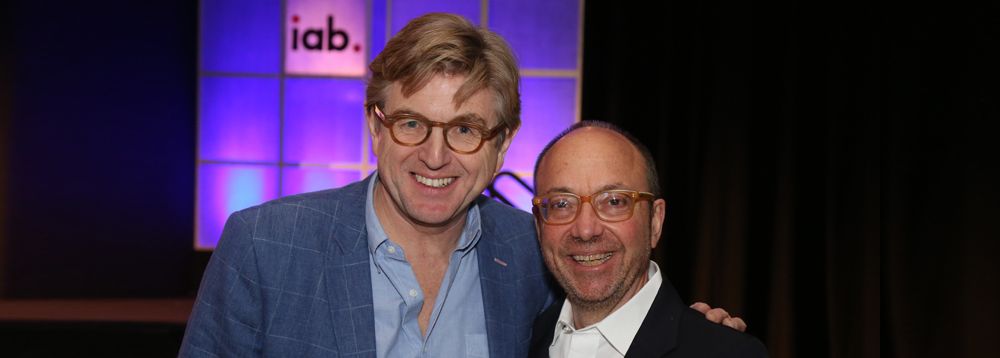
Image over the headline.- Keith Weed Unilever’s CMO -left- and Randall Rothenberg (CEO IAB) at the IAB Annual Leadership Meeting 2018. © IAB