Most consumers (61%) are aware of several options for removing advertising such as ad blockers. The survey carried out among 28,000 consumers across 28 countries also finds that more than four in 10 (42%) said they would pay to eliminate ad interruptions. This reveals the latest digital survey by Accenture.
Regionally, ad-blocker awareness is especially pervasive in Latin America (78%) and the Middle East (69%). In addition, consumers in emerging markets are significantly more likely than those in mature markets (47% against 34%) to say they plan to pay to expunge ad interruptions.
“Ad blockers are a relatively new threat to the digital advertising industry,” said Gavin Mann, Accenture’s Global Broadcast Industry lead.
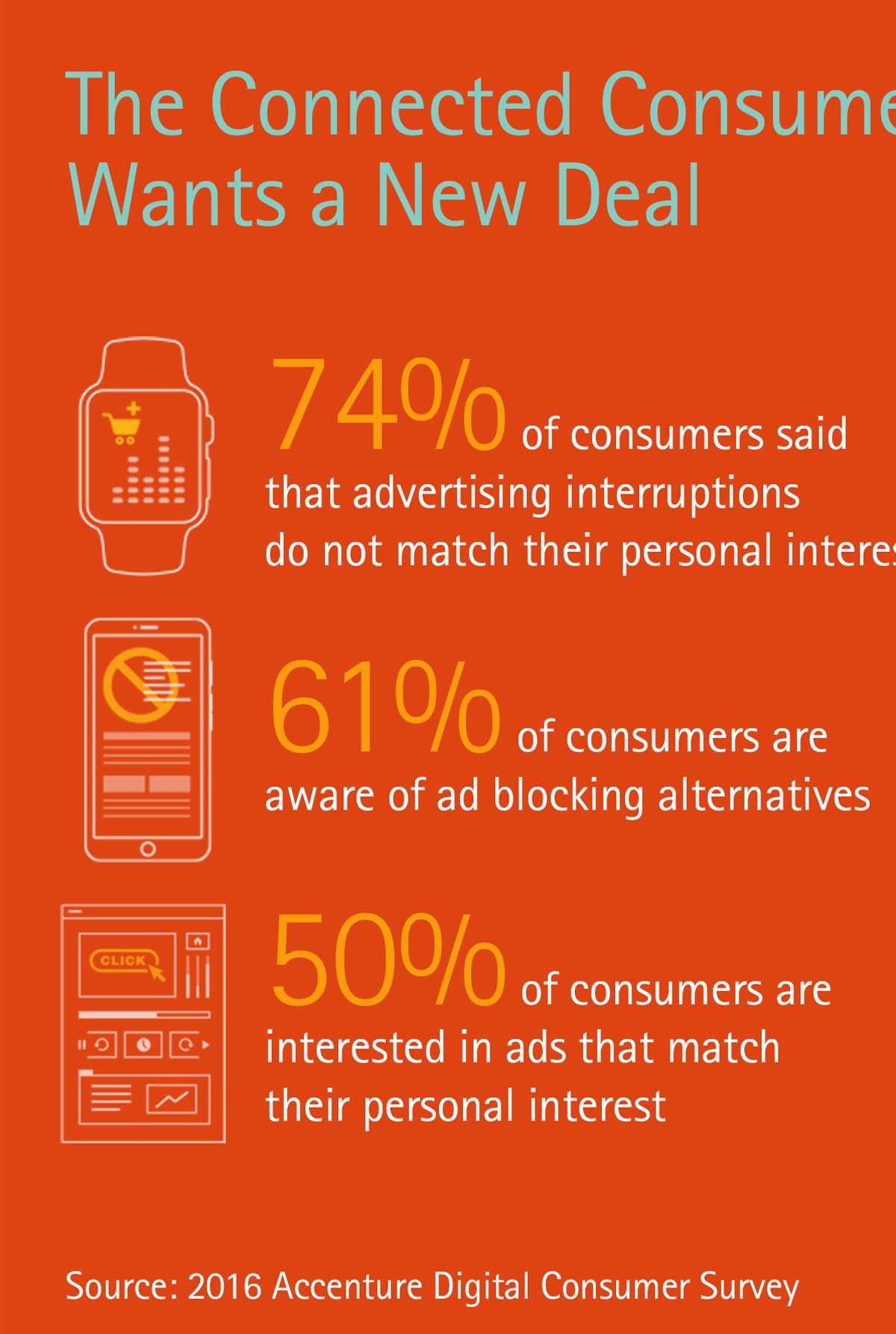
“Consumers are increasingly willing to pay for blockers because too many ads are poorly targeted. In today’s world of personalized content, being forced to watch an ad that has no relevance is a missed opportunity and feels increasingly intrusive on precious screen-time. In fact, simple avoidance of content associated with heavy and repetitive irrelevant advertising will increase as consumer choice and awareness of choice increases.”
Ad blockers awareness higher among the youngest
Young consumers are especially aware of ad blockers compared with older age groups. More than two-thirds (69%) of those aged 18-to-24, and almost the same number (66%) of those between 25 and 34, say they know about ad-interruption technologies.
Also higher awareness in emerging markets
Awareness of ad-blocking methods is more prevalent among consumers in emerging than in developed markets. For instance, two-thirds (65%) of respondents in emerging-market countries said they know about ad-blockers compared with (58%) in mature-market countries. Awareness of these technologies is especially high in Mexico, at 82%, whereas only 55% of consumers in the United Kingdom know about ad blockers.
Why adblockers are on the rise
Ad blockers are technological methods for automatically removing or altering advertising content such as videos, images, and text on a Web page.
The blockers enable TV, smartphone, tablet and PC users to load video files more quickly, view more clean-looking Web pages, reduce bandwidth consumption, and increase their privacy by removing tracking and profiling systems of video advertising delivery platforms.
Advices to fight against Adblockers: tech investement to improve creativity and relevance in targetting
Drawing upon its industry consulting capabilities and knowledge of digital transformation, Accenture recommends that digital advertising organizations invest in user experience and user interface transformation, production studios, and post-production support resources and facilities. Equipped with a wealth of operational and analytical technologies that can be applied to solve these business problems, advertising can deliver value-added creative capabilities and more robust customized services to consumers.
The sample: 28,000 accross 28 countries
Between October and November 2015, Accenture carried out its online survey with 28,000 consumers in Australia, Brazil, Canada, China, Czech Republic, France, Germany, Hungary, India, Indonesia, Italy, Japan, Mexico, Netherlands, Philippines, Poland, Romania, Russia, Saudi Arabia, Slovakia, South Africa, South Korea, Spain, Sweden, Turkey, United Arab Emirates, United Kingdom, and the United States.
The sample in each country was representative of the online population, with respondents ranging in age from 14-to-55 and over.
The survey and related data modelling quantify consumer perceptions of digital devices, content and services, purchasing patterns, preference and trust in service providers, and the future of their connected lifestyles.
Image over the headline.- shortcut of the Accenture DIgital Survey infographic.
Related Eastwindlinks: